TL;DR
- Most Christians using AI lack a framework for faithful use.
- This article provides five biblical tests—authorship, voice, truth, stewardship, and glory—to help Christian messengers ethically leverage AI as a tool that amplifies their calling, rather than an outsourcing mechanism that hollows it out.
A pastor I was speaking with recently told me he had started using an AI tool to help him prepare, and then he lowered his voice slightly, the way people do when they are about to admit something they are not sure they are allowed to say. He said he felt strange about it. Not because the tool had done anything wrong, but because he could not work out whether using it at all was faithful. He had the sense that he might be crossing a line he could not quite see.
I have heard some version of that quiet unease from a great many Christian messengers over the past two years. Pastors, authors, teachers, coaches, ministry leaders. They are reaching for these tools because the tools genuinely help, and at the same time they are carrying a question they have not been given any real help to answer. Is this faithful? Am I cheating somehow? Is there something about being a Christian that means I should not be doing this?
I want to take that question seriously in this article, because it deserves a serious answer, and most of the answers being offered are not serious. They are reflexes. And a reflex is not the same thing as discernment.
The question is good — but the genie is already out of the bottle
Let me name the reality first, because it changes how we should approach the question.
Whatever any of us thinks about the ethics of AI in ministry, the Church has already decided with its hands what it is still debating with its mouth. A 2025 nationwide survey conducted by AiForChurchLeaders.com and Exponential AI NEXT, drawing on responses from 594 church leaders, found that 61% of pastors now use AI weekly or daily, up from 43% only a year earlier. Nearly two-thirds use it specifically in preparing their sermons. And around nine in ten church leaders said they support its use in ministry to some degree.
That is not a fringe phenomenon. That is the mainstream of working ministry, happening right now, mostly quietly, often without anyone in the pews knowing it is happening at all.
So the question "is it ethical for Christians to use AI?" is no longer a question we are asking before the fact. We are asking it in the middle of a practice that has already become normal. And that means the unhelpful answers are even more unhelpful than they would otherwise be.
There are two unhelpful answers I encounter most. The first treats AI as the enemy — a kind of digital threat to spiritual life that the faithful Christian should refuse on principle. The second treats it as obviously fine — just a tool, like a calculator or a search engine, nothing to think about. What I have come to learn is that both of these answers do the same thing underneath. They let the person skip the actual work of discernment. One skips it by refusing. The other skips it by shrugging. Neither one helps the pastor who lowered his voice, because his instinct was actually right. There is a line. He just had not been given the categories to locate it.
The real question was never whether. It is how.
What the Church is rightly afraid of
Before I offer a framework, I want to honour the fear, because the fear is not irrational. The same 2025 survey that documented how widely pastors have adopted AI also documented what they are worried about, and they are worried about exactly the right things.
The single biggest ethical concern church leaders named was theological misalignment — AI producing content that drifts from sound doctrine. After that came the fear that AI would diminish genuine human connection, and then concerns about privacy and the handling of sensitive data. When leaders were asked to name the single most significant risk, the largest group pointed to misinformation — the danger that these tools confidently produce things that are simply not true.
These are not the anxieties of people who do not understand the technology. These are the anxieties of shepherds. A shepherd worries about his people being fed something subtly false. A shepherd worries about the warmth of real presence being replaced by something colder and more efficient. A shepherd worries about handling what people have entrusted to him with care. The fear, properly understood, is pastoral wisdom showing up as caution.
And here is the part of the picture that should sober all of us. That same research found that only around six percent of ministries have any formal policy governing how AI is used, while roughly three-quarters have nothing at all. So we have a field that has adopted a powerful technology faster than almost anyone expected, that is rightly worried about the deepest risks, and that has almost no framework for using it faithfully. The practice has raced ahead of the thinking. That gap is the most important thing to understand about this whole conversation.
What Scripture and the Christian tradition actually give us
The Bible does not mention artificial intelligence. Anyone who tells you there is a verse that settles this question directly is not reading carefully. But the absence of a proof-text does not mean the absence of guidance, because Scripture gives us something better than a rule for every new tool. It gives us principles durable enough to apply to tools that did not exist when it was written.
The first principle is that a tool is not a moral agent. This sounds obvious until you watch how people actually talk about AI, as though the machine itself could be holy or unholy, faithful or unfaithful. The Ethics and Religious Liberty Commission, in its evangelical statement of principles on artificial intelligence — the first faith-based statement of its kind, signed by around seventy evangelical leaders — put this carefully. They affirmed that while a technology can be made with a moral use in view, it is not itself a moral agent, and that human beings alone carry the responsibility for moral decisions. That is the right starting point. The AI does not sin and does not obey. You do. The moral weight never transfers to the tool. It stays on the person holding it.
There is a second principle layered on top of that one, and it concerns the manner of our work, not only its output. When the Southern Baptist Convention addressed these technologies in a 2023 resolution, it urged those who use them to do so in ways that are honest, transparent, and Christlike — focused on loving God and loving neighbour. I find that framing clarifying, because it refuses to reduce the question to results. It is not enough that the sermon was good or the book got written. The way it was made has to be able to stand in the light.
And underneath both of those sits the oldest principle of all, the one that runs through the whole of Scripture's teaching on work: we are stewards, not owners. In the parable in Luke 19, the servants are given resources and expected to put them to work — pragmateuomai, to trade, to do business, to make the deposit productive — until the master returns. The point of the parable is not the tool the servants used. The point is what they did with what they were given, and whether they were faithful or fearful in the using of it. A tool, in that frame, is something you will give an account for — not because the tool is dangerous, but because stewardship is always accountable.
Put those three together and you do not get a yes or a no. You get a way of testing.
Five tests for faithful AI use
Here are the five tests I use, and that I would put in the hands of any Christian messenger trying to locate the line the pastor sensed but could not see. They are not abstract. Each one is a question you can ask of any specific use of AI, and the answers tell you whether you are on faithful ground.
The first test is authorship and honesty. Are you the true author of what carries your name, or are you misrepresenting where the work came from? This is the question of bearing false witness, applied to creative and ministry work. There is a real difference between using AI to help you develop and express what is genuinely yours, and passing off as your own labour something you did not actually think, wrestle with, or believe. The congregation that listens to a sermon is, as one ministry ethics writer put it, expecting the fruit of their pastor's own study and reflection. If what they are receiving is something else entirely, dressed up to look like personal labour, the problem is not the AI. The problem is the deception.
The second test is voice and integrity. Is the work still recognisably you, or has it become a generic substitute wearing your name? This is subtler than honesty, but it matters. A message carries a person. When the words that go out under your name no longer sound like you, no longer carry your convictions and your particular way of seeing, something has been hollowed out even if no one has technically been lied to. Faithful use keeps you in the work. Unfaithful use slowly replaces you with an average.
The third test is truth and theological soundness. Is what you are producing both factually honest and doctrinally faithful? This is the test the Church named as its highest concern, and rightly so. These tools can produce things that are plausible and wrong — confident sentences that contain errors, and theological claims that drift from Scripture in ways a careless user would never catch. The principle here is non-negotiable. You remain the arbiter of truth. The pastor, not the machine, is responsible for ensuring that what is taught faithfully reflects God's Word. An AI can draft, suggest, and assemble. It cannot discern sound doctrine, and it must never be trusted to. Everything it produces passes under your judgment before it reaches anyone you are responsible for.
The fourth test is stewardship versus sloth. Is this tool amplifying the gift God gave you, or is it replacing the labour and the prayer that your calling actually requires? This is where discernment gets genuinely hard, because the same action can be either faithful or faithless depending on what it is replacing. Using AI to transcribe a sermon you preached from your own study, so that it can reach people who were not in the room, amplifies real work. Using AI to avoid the study altogether, so that you can stand up with something you never sat down with God to receive, replaces the very thing you were called to do. The tool is identical. The stewardship is opposite. There are parts of the work that can be assisted, and there are parts that must never be outsourced — the prayer, the wrestling, the formation that happens in you while you prepare. Know which is which.
The fifth test is glory and formation. Does the work still point to God and deepen your walk with Him, or does it quietly hollow out your spiritual life and serve yourself? This is the test that sits underneath all the others, because it asks about direction. Over months and years, is your use of these tools making you a deeper, more prayerful, more dependent servant — or a faster, shallower, more self-reliant producer? The honest answer to that question over time tells you more than any single decision about a single tool.
Where AI use becomes genuinely unfaithful
I want to be just as clear about the failures as about the freedoms, because a framework that only ever says yes is not a framework. It is a permission slip.
There is genuine unfaithfulness available here, and it is worth naming plainly. There is the deception of passing off generated work as personal labour, especially in the pulpit, where the trust between a shepherd and a congregation is sacred. There is the spiritual outsourcing of handing the machine the parts of the work that were always meant to form you — letting it do the praying and the wrestling, so to speak, so that you arrive at Sunday hollow but on schedule. There is doctrinal drift, where a steady diet of plausible, unexamined output slowly bends what you teach away from what is true. And there is the quiet abandonment of discernment, where the convenience becomes such a relief that you stop checking, stop testing, stop reading what goes out under your name with your own prayerful judgment.
None of these is a reason to refuse the tools. All of them are reasons to use them as a steward who knows he will give an account.
What faithful use actually looks like
The most helpful image I have encountered for faithful use comes from a ministry context, and it is worth borrowing. Think of AI as a kitchen assistant rather than the head chef. The assistant can prepare, gather, and speed the work along, but the chef remains responsible for the vision and the execution — and the chef's name is on the meal. In ministry terms, the tool can help with the parts that surround the work, but it does not replace the prayerful, Spirit-dependent, personal labour at the centre of it. You remain the head chef. You remain the author. You remain the steward who will answer for what was served.
What this means in practice is that faithful use keeps the human being in the load-bearing position at every point that matters. The convictions are yours. The discernment is yours. The final word over everything that goes out is yours. The tool accelerates and assists; it does not author and it does not absolve. When that ordering holds, AI becomes what stewardship always makes of a good tool — a way to be more fruitful with what God has entrusted to you, rather than a way to be less faithful more efficiently.
A worked example: AI built around these convictions
I want to be honest about why I built what I built, because it is directly relevant to everything above.
When I watched Kingdom messengers reaching for these tools — and the research confirms they are reaching for them in enormous numbers — what struck me was not that they were using AI. It was that almost none of them had any framework for using it faithfully. Recall the figures: a field where most pastors now use AI weekly, where the deepest worry is theological drift, and where only around six percent have any policy governing its use. Into that gap, the general-purpose tools were arriving first — the broad assistants and writing tools built for everyone and no one in particular, which most church leaders were already using by default.
I did not want to add another general-purpose content machine to that pile. So rather than build a faster way to generate Christian-sounding output, I built Kingdom Builders AI Studio™ around the very questions this article has been working through. I am not going to claim it is the biggest or the only environment of its kind — the landscape includes Bible-software assistants, sermon tools, and the general writing assistants pastors already reach for, and that landscape will keep growing. What I will claim, and stand behind, is that I am not aware of another AI environment built deliberately from the ground up around the stewardship and voice-integrity concerns that matter most to a Christian messenger. That gap is real, the research shows it is real, and it is the gap the Studio exists to fill.
The way those convictions are built into the architecture maps onto the five tests almost directly.
On authorship and integrity, the Studio is built around a Voice DNA profile — a structured capture of how you actually write and speak — so that what it produces is oriented toward your real voice rather than the generic average. The aim is the opposite of replacing you. It is keeping you in the work.
On truth and soundness, the human stays the arbiter at every gate. The Studio's drafting tools include a critical review pass on book manuscripts that flags where the work has drifted or weakened, precisely so that you catch problems before a reader does — but the judgment about what is true and faithful never leaves your hands. The tool surfaces concerns. You decide.
On message integrity, the foundation of the whole Studio is a tool that helps you name and clarify your framework, your convictions, your message — before anything is generated. The point is that the content downstream is an expression of what you actually believe, not a substitute manufactured in place of it.
And on stewardship, the entire design assumes the human as head chef. Nothing in the Studio is built to let you skip the formation at the centre of your calling. It is built to take the message you have already paid for in study, obedience, and suffering, and help you steward it so that it reaches the people it was given for.
That is the example. Not a claim that a tool can be holy — no tool can. A claim that a tool can be built by people who took these questions seriously, so that using it well is made easier rather than harder.
Back to the pastor who lowered his voice
The pastor's unease was not a sign that he was doing something wrong. It was a sign that his conscience was working. The discomfort was discernment trying to happen without the categories it needed.
The categories, in the end, are not complicated. A tool is not a moral agent; you are. The manner of your work matters to God, not only the result. You are a steward, and stewards give an account. Run any use of AI through authorship, voice, truth, stewardship, and glory, and the line the pastor sensed becomes visible. On one side of it, AI amplifies a faithful servant's stewardship of a real gift. On the other side, it replaces the very labour and formation the gift required. Same tool. Opposite faithfulness.
So, is it ethical for Christians to use AI? Used as a steward uses a tool — honestly, in your own voice, under your own discernment, in service of God's glory rather than your own convenience — yes. Used to deceive, to replace your formation, to drift from truth, or to serve yourself while appearing to serve God — no. The technology does not decide that. You do.
That was always the more demanding answer. It is also the only honest one.
Where to go next
If you want to see what AI built around these convictions looks like in practice, you can explore Kingdom Builders AI Studio™ at kingdombuilders.studio — not as a tool that replaces your calling, but as an environment built to help you steward it.
If you are earlier in the question — still working out what you actually carry and how it is meant to be converted into Kingdom fruit — the Capital Conversion Gap™ Diagnostic at capitalconversiongap.com is a good place to begin. It takes about seven minutes.
Frequently Asked Questions
Is it a sin for a Christian to use AI?
No tool is inherently sinful, because a tool is not a moral agent — the moral responsibility rests with the person using it. AI use becomes sinful when it involves deception (passing off generated work as your own labour), when it replaces the prayer and formation your calling requires, or when it spreads what is false. Used honestly, in your own voice, under your own discernment, it is not sinful.
Is it wrong for a pastor to use AI to write sermons?
The widely shared principle among church leaders is that AI may assist with the work surrounding a sermon — research, illustrations, administrative tasks — but should not replace the prayerful, Spirit-dependent study at the centre of it. Using AI to avoid that study is the problem. Using it to extend a message you genuinely received and prepared is a different matter. The congregation's trust that they are receiving their pastor's own study and reflection must be honoured.
What does the Bible say about artificial intelligence?
Scripture does not mention AI directly, but it gives durable principles: humans, not tools, bear moral responsibility; the manner of our work matters to God; and we are stewards who will give an account for what we do with what we are given (Luke 19). These principles apply to AI as they apply to any tool.
How can I use AI without losing my own voice and integrity?
Keep yourself in the load-bearing position. Ensure the convictions, the discernment, and the final word over everything that goes out remain yours. Use AI to amplify and assist work that is genuinely yours rather than to generate a generic substitute. Tools that are built to capture and preserve your actual voice make this easier than general-purpose tools that default to a generic average.
What is the biggest ethical risk of AI in ministry?
Research on church leaders points to theological misalignment and misinformation as the leading concerns — the danger that AI produces content that is plausible but false or doctrinally unsound. The safeguard is that the human remains the arbiter of truth: everything an AI produces must pass under your prayerful, informed judgment before it reaches the people you are responsible for.
About the author
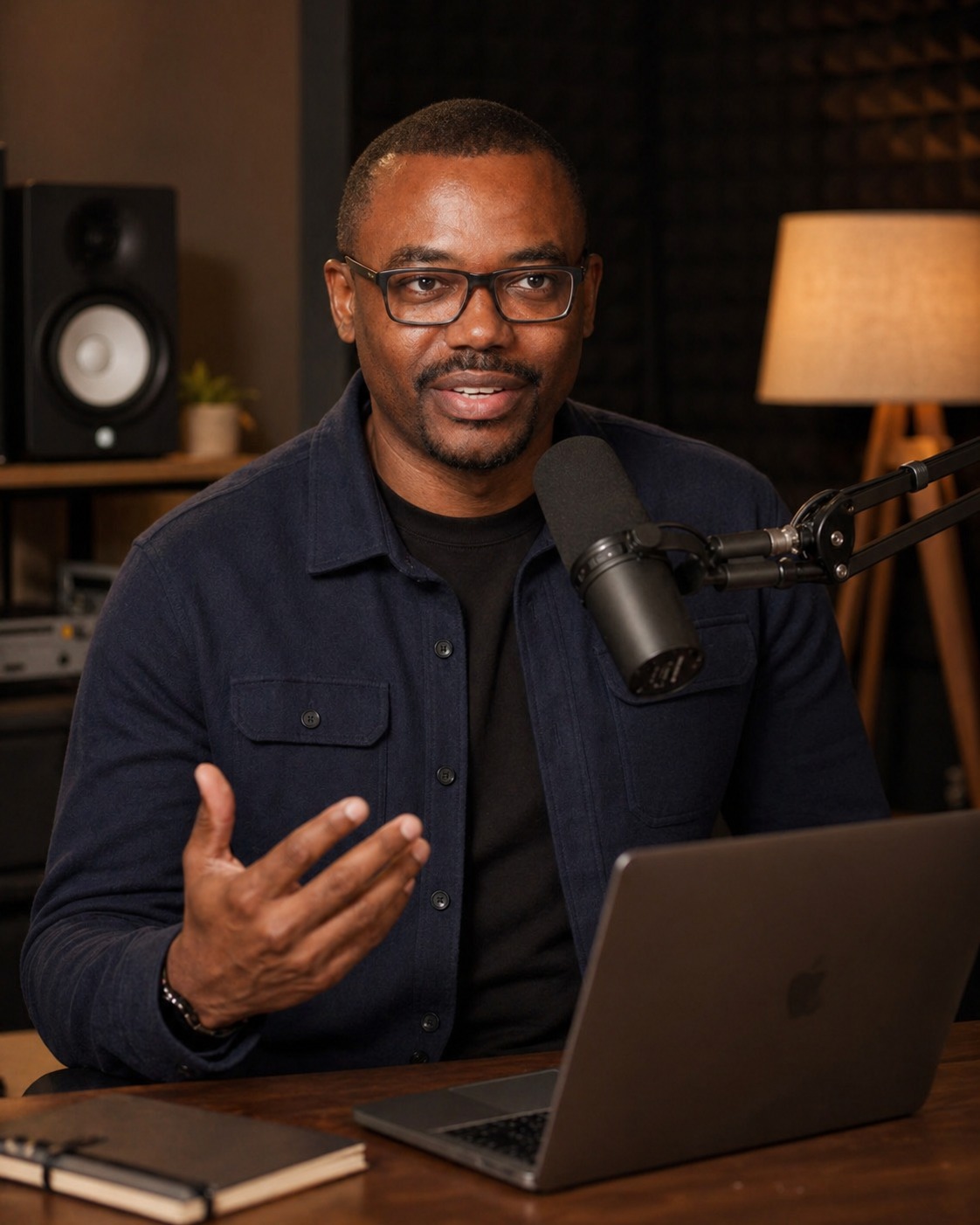
Dr Uche Okere
Dr Uche Okere is a pastor, university academic, coach and founder of Kingdom Builders AI Studio. He helps pastors, authors, speakers and faith-driven builders convert spiritual capital into visible Kingdom impact through message architecture, AI tools, workshops and practical implementation.
Explore the Studio