
TL;DR
- Most pastors and Christian authors do not need a new book idea — they need to call for their parchments.
- The reason a serious messenger has not yet finished a book is rarely a writing problem.
- It is a conversion architecture problem.
- Here is how to turn a sermon archive into a structured manuscript and pathway without losing your voice, and the tool we built to help you do it.
In this article
- 01The book is rarely missing — it is usually scattered
- 02Call for your parchments
- 03The book inside an archive is not just a book — it is a vehicle
- 04Why the book has not appeared
- 05What sermon stewardship actually means
- 06A way to begin — the conversion sequence
- 07The Message-to-Book Builder™ — the tool we built for this work
- 08Where to take the next faithful step
- 09FAQ
I want to begin with a sentence I have said quietly to more than one pastor in the last two years: you may not need a new book idea, you may need to call for your parchments.
For some of you reading, that line will already land. You will know exactly what I mean before I unpack it. For others, it will sit on the surface until I take it apart, and that is what I want to do here, because I have come to learn that the most common reason serious Christian messengers do not have a book is not that they have nothing to say. The reason is that what they have been carrying for years has never been gathered, named, structured, and converted into a vehicle that can travel.
What I see, when I sit with pastors and authors and coaches and ministry leaders, is rarely an empty well. What I see is a long pastoral life, a long teaching life, a long obedience in a particular direction, that has produced a quiet mountain of created capital — sermon notes, outlines, slides, recordings, journal entries, frameworks, counselling insights, half-written drafts, retreat talks, and the small notebooks no one else has ever opened — and yet the book has not appeared. And because the book has not appeared, the message has stayed local, when it was formed to travel.
This article is for that person. It is for the pastor who has preached for fifteen years and assumes the book has to begin from a blank page. It is for the Christian author who started a manuscript in 2019 and has been carrying it as a slow form of guilt ever since. It is for the speaker who keeps giving the same keynote and has never paused to ask what God might be forming through the repetition. It is for the coach whose framework is in the slides but not yet in a structured pathway. It is for the ministry leader who has, by faithfulness alone, accumulated more substance than they have made visible.
I want to help you see what is actually happening, and what to do about it.
01The book is rarely missing — it is usually scattered
Let me start with the diagnosis, because diagnosis matters more than motivation here.
When a serious messenger tells me they have not written their book, I almost never believe the surface story. I do not mean that as an insult. I mean that, in my experience, the surface story — I have not had time, I am not a writer, I am still praying about it, I do not know where to start — is rarely the real story underneath. The real story is that the material has not yet been gathered, the message has not yet been named, the reader has not yet been defined, the voice has not yet been captured, and the structure has not yet been built. None of that is a writing problem. All of it is an architecture problem.
In the Capital Conversion Gap™ framework, this has a specific name. The believer is rich in created-works capital — books, courses, recorded sermons, music, curricula, frameworks already produced — but poor in deployed outcomes, because the conversion architecture between the artefact and the people it was made for is missing. That is a quiet form of unfaithfulness, but it is not the unfaithfulness most people fear. It is not laziness, and it is not lack of calling. It is the unfaithfulness of a steward who has gathered without yet trading, and who therefore lives with a low-grade tension that the gathered substance was meant to do something it has not yet been free to do.
What I have come to learn is that this gap rarely closes by working harder. It closes when someone names the material correctly, lays it out, and applies the right architecture to it. That is what the rest of this article is about.
02Call for your parchments
Near the end of his life, Paul writes a short and very human letter to Timothy and asks for three things. He asks for his cloak, which he had left at Troas. He asks for the books. And then he says something that has stayed with me for years: especially the parchments (2 Timothy 4
).I am careful with this passage, because we do not know exactly what those parchments contained. I have never preached that we know. What we know is that Paul, at the end of his ministry, with execution in view, regarded those parchments as valuable enough to ask for by name. They were not new revelation. They were materials from another season of his life and ministry. He had carried them, he had set them down somewhere, and he wanted them back, because there was still work for them to do.
The principle there is worth slowing down for. Wisdom from one season does not have to remain confined to that season. The material God formed in you ten years ago, five years ago, last year, was not formed only for the room you were in at the time. It was formed in you, and what is formed in you is portable.
So when I say to a pastor, you may need to call for your parchments, I mean it pastorally and I mean it practically. Your parchments may be a folder of sermon manuscripts on an old laptop. They may be the Evernote you abandoned. They may be the legal pad in the desk drawer with the framework you drew out one Tuesday morning at 5am. They may be the voice notes from the drives home, the YouVersion notes on a Bible app, the unfinished doc called Book Idea v3, the marked-up Moleskine from the year your father died, the printed-out outlines from the retreat you led in 2018.
That is created capital. It is real. It is already paid for, in study and obedience and suffering and mastery. The question is not whether it exists. The question is whether you will gather it, structure it, and let it travel further than it has so far.
03The book inside an archive is not just a book — it is a vehicle
Here is where I want to be careful, because I do not want to flatten the conversation into every pastor should write a book. That is not what I am saying.
What I am saying is that, for a particular kind of messenger, a book is one of the most efficient vehicles for the conversion of created capital into ongoing Kingdom impact. The book is not the highest aim. The reader is the aim. The lives the message can serve are the aim. The book is a vehicle.
When the vehicle is built properly, several things happen at once.
The book serves people the messenger will never personally meet. A pastor of a two-hundred-seat church can serve only so many people in a Sunday lifetime. A book can sit in the hands of someone they have never met, in a country they have never visited, in a season they will not live to see. That is multiplication that no amount of preaching alone can produce.
The book clarifies the message for the messenger themselves. I have watched pastors who have preached for two decades suddenly see, while writing chapter three, what they have actually been saying the whole time. The book becomes a mirror that returns their own message to them in a more concentrated form.
The book becomes the centre of a wider pathway. A book can lead to a workshop. A workshop can lead to coaching. Coaching can lead to mentorship. Mentorship can lead to a deeper community of discipleship. None of that begins to flow when the message is trapped in sermon recordings that only a small audience ever finds. It begins to flow when the message has a structured container that travels.
The book becomes a credibility instrument that opens doors the messenger could not otherwise open. This is not vanity. This is faithfulness. The book opens the door, but the message walks through.
So yes, the book matters. But the reason it matters is not that every Christian leader should have a book. The reason it matters is that, for the messenger whose substance has been forming for years, the book may be the most strategic vehicle available for the next season of conversion.
04Why the book has not appeared
Let me name what I see most often, because the diagnosis is usually one of these patterns, and you will probably recognise yours.
The first pattern is the unclarified message. The pastor has preached on many things, faithfully, for years. But they cannot say in one sentence what their book is actually about. They have not yet locked the burden. Without a locked burden, the writing meanders, the chapters bleed into one another, and the project stalls.
The second pattern is the undefined reader. The author is writing for everyone, which means they are writing for no one. They have not yet asked the harder question: which person, in which struggle, am I actually trying to serve? When the reader is undefined, the book cannot find its voice, because voice is partly a function of who you are speaking to.
The third pattern is the unbuilt spine. The author has good thoughts, scattered illustrations, and a stack of sermons, but no transformational architecture. The book is informational, not transformational, which means the reader finishes it impressed but unchanged. There is no movement from pain to pause to promise to pathway, no clear turn that the reader is asked to take.
The fourth pattern is the uncaptured voice. This is the deepest fear of the serious messenger. Will it sound like me, or will it sound like a generic Christian book? It is a holy fear and it should be honoured. A book that does not sound like the author is, for a pastor or teacher, a small form of betrayal of the people who have learned to trust that voice.
The fifth pattern is the unbuilt pathway. The author finishes the book, but there is nothing on the other side of the last page. No workshop. No reader next step. No way for the person who finished the book to keep walking. The book becomes a tombstone rather than a door.
Look honestly at those five patterns. In most stalled book projects I have seen, two or three of them are present at once. The reason the book has not appeared is not that the messenger lacks capacity. It is that one or more of those five architectural pieces has been missing, and effort alone cannot close an architecture gap. Effort writes faster. Architecture moves the project forward.
05What sermon stewardship actually means
I want to use a specific phrase here because it matters. The work of converting a sermon archive into a book is not recycling content. That language belongs to a different world. I do not use it for Kingdom work. The work is sermon stewardship, and it is a serious theological category.
A sermon, in the moment it is preached, does its primary work. The Word lands, the Spirit moves, the local body is fed. That is the first conversion of the message. But the formation that went into the sermon — the years of study, the prayer in the early mornings, the wrestling with the text, the pastoral observation that made the application possible — does not stop being useful when the service ends. It is still alive. It can still serve people in a different form, in a different medium, in a different season.
Sermon stewardship is the discipline of asking: what else can this faithfully serve? Could the series on identity become a book that helps a stranger walking through a divorce in Lagos at 2am? Could the framework on stewardship become a course for a young entrepreneur in Manchester? Could the teaching on fatherhood become a small devotional that a Christian father reads on the train? Could the sermon on grief from the week your member lost their child become a single chapter that meets another grieving person five years from now?
What I have come to learn is that the messengers who steward their sermons faithfully end up with more, not less. They do not lose the sermon. They multiply it. The local church is still served. The wider Body is also served. The work God did in them becomes a wider river.
This is what I mean when I say a sermon archive is created capital. It is not nostalgia. It is not vanity. It is real material, already formed, waiting to be converted.
06A way to begin — the conversion sequence
I do not want to leave you with conviction and no movement, because conviction without a next step is one of the cruellest things a teacher can do to a serious reader. So here is what I would do if you have read this far and recognised yourself in the description.
First, stop writing for a moment. Counter-intuitive, I know. But the worst thing you can do, if your archive is sitting in twelve folders across five devices, is open a new blank document. The blank document is not where the book is. The book is in the archive. Go to the archive.
Second, gather the parchments. Find the sermons. Find the notes. Find the recordings. Find the drafts. Put them in one place. Do not edit yet. Do not structure yet. Just gather. You will be surprised how much you have.
Third, lock the message. Ask one honest question: across all of this material, what is the one burden God has actually formed in me? Not the ten things I have preached on. The one thing that keeps surfacing, in different shapes, across different years. That is your book. It has been forming in you the whole time. You did not notice because you were preaching.
Fourth, define the reader. Not the audience. The reader. One person. Their situation, their pain, their tension, the room they are in when they pick up the book. The clarity here will do more for your writing than any course on grammar.
Fifth, capture the voice before you write a single chapter. This is the step most authors skip and most regret skipping. Your voice is not a luxury. It is the trust signal that allows your reader to receive the message. If the book sounds like a stranger, the message will not land, no matter how true it is.
Sixth, build the spine, then write the chapters. The spine is the architecture. The chapters are the rooms. You do not build a house by starting with the bedroom curtains.
Seventh, build the pathway as you go. Decide, before the book is finished, what is on the other side of the last page. A workshop? A course? A coaching pathway? A mentorship? A small community? The reader who finishes your book should not be left standing in a corridor with no door. Build the door before you finish the book.
That sequence, when followed honestly, will move more projects from stalled to shipped than any amount of writing motivation. The pattern is older than any of us. Faithful messengers have always gathered, clarified, structured, voiced, and deployed. The difference now is that we have tools that can assist the conversion without replacing the formation.
That is exactly why we built the Message-to-Book Builder™.
07The Message-to-Book Builder™ — the tool we built for this work
When I sit with pastors and authors and Christian messengers who have been carrying a book for years, the gap between the burden inside them and the book on the page is not a willpower gap. It is an architecture gap. They have everything they need, and they cannot move. They open the document, write three chapters, lose the thread, set it down, and pick it up six months later only to find the voice has changed and the message is now slightly out of focus. They do not need more motivation. They need a structured pathway from message to manuscript that respects the substance they already carry.
The Message-to-Book Builder™ is the tool we built for that work, and it sits inside Kingdom Builders AI Studio™ as one of the most direct expressions of the conversion architecture this article has been describing.
What makes the Builder different from generic AI writing tools is the order of operations. Most AI tools start with a prompt. That is why so many AI-assisted books sound flat, theologically thin, and recognisably synthetic. The Builder does not start with a prompt. It starts with your message, your source material, and your authentic voice. The author remains the author. The tool assists the stewardship.
Practically, the Builder walks you through the same seven-step sequence I just laid out for you. You gather your parchments by uploading sermons, notes, transcripts, outlines, posts, and drafts. The Builder helps you lock the message by surfacing repeated themes, core burdens, and the strongest claims across your material. It helps you define the reader by building a dossier of the specific person you are writing to. It captures your Voice DNA by analysing your existing teaching and writing samples and building a voice profile that shapes every chapter the system helps you draft. It builds the transformational spine using the 7Ps — Pain, Pause, Promise, Pathway, Practices, Proof, Propelling — so the book moves the reader rather than merely informing them. It generates the chapter architecture, walks you through guided drafting chapter by chapter, and runs a critique pass on the manuscript for clarity, voice drift, theological coherence, and reader movement. And it helps you build the launch pathway — the book description, the endorsement asks, the launch sequence, the workshop bridge, and the reader next step — so the book does not arrive into silence.
What you walk away with is a structured, voice-matched manuscript shaped around transformation, plus the launch and repurposing assets that turn the book into a pathway rather than a tombstone.
Let me also say clearly what the Builder is not, because I think it matters. It is not a book-in-one-click tool. I would not build one of those and I would not want you using one. It is not a replacement for formation, revelation, or pastoral responsibility. It is not a generic AI wrapper repackaged with Christian language. The Builder assists. It does not author. You remain the messenger. The tool helps you steward the message responsibly into a form that can travel.
If the work I have described in this article is the work you have been trying to do alone, the Builder is the tool we built so you would not have to.
08Where to take the next faithful step
If this article has named something you have been carrying, the most useful thing I can do now is point you to three doors, in order of readiness.
The first door is the Capital Conversion Gap™ Diagnostic at capitalconversiongap.com. It will help you see, in writing, where your spiritual capital is failing to convert into visible Kingdom outcomes. If created-works capital is your strongest category, you will see it clearly, and the diagnostic will tell you what to do next. Start here if you are not yet sure whether the book is your right next vehicle.
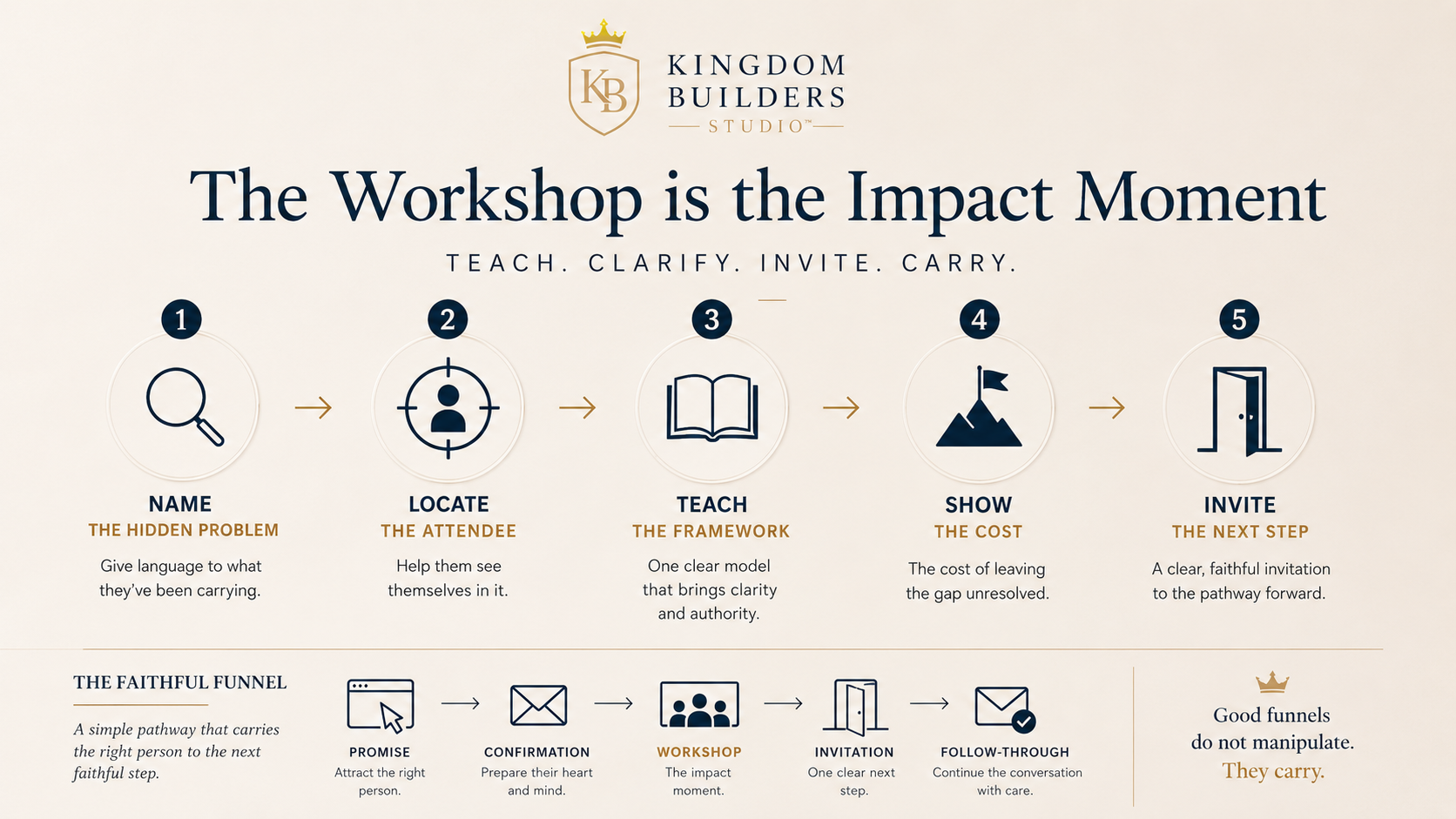
The second door is our regular workshop on turning your message into a book, course, or Kingdom impact pathway at kingdombuilders.studio/workshop. It is not a webinar in disguise. It is a working session where we name the gap, walk through the conversion architecture, and show you how to begin gathering and structuring your parchments responsibly. Come here if you want to walk the framework with us in a live room before you begin.
The third door is the Message-to-Book Builder™ itself, at kingdombuilders.studio/book. Open this door if you are ready to begin the conversion work — if your parchments are real, your burden is forming, and you want a structured pathway from message to manuscript that respects your voice and connects the book to a wider impact pathway.
You have probably already done the hard work. You have studied, prayed, preached, counselled, suffered, loved, and led. The substance is real. The capital is real. The book inside the archive is real.
Now it is time to call for your parchments.
09FAQ
Do I really have enough material in my sermons to make a book?
In most cases, yes — but the question is not quantity. Most pastors with even three years of consistent preaching have more material than a single book can hold. The real question is whether one clear message, with one clear reader, can be identified inside the archive. That is the first thing the Message-to-Book Builder™ helps you do. It surfaces the repeated themes, the core burdens, and the strongest claims across your material so the book is built around what you actually carry, not around what feels topical.
Will my book sound like ChatGPT if I use AI to help me?
It depends entirely on the tool and the order of operations. Generic AI tools start with a prompt, which is why so many AI-assisted books sound flat. The Message-to-Book Builder™ is built differently — it begins with your message, your source material, and your authentic Voice DNA, and it shapes the manuscript around what you actually carry. The author is still the author. The tool assists the stewardship.
Is it theologically responsible to turn my sermons into a book?
Yes, when done with integrity. A sermon does its primary work in the moment it is preached. Sermon stewardship is the further work of asking what else the formed material can faithfully serve. This is closer to the older tradition of pastoral writing — Spurgeon, Lloyd-Jones, Tozer — than to modern content recycling. The line to watch is honesty. Do not pretend the book is something it is not. If it is built from sermons, let that be visible and let it be a strength.
Do I have to be famous or have a platform to make this worthwhile?
No. The aim is not to become famous through a book. The aim is to convert created capital into a vehicle that can serve the reader God placed on your heart. A book with a small but well-served readership, connected to a clear pathway, will outperform a book with a large audience and no pathway, in Kingdom terms.
Where should I start if I am not sure my message is clear yet?
Start with the Capital Conversion Gap™ Diagnostic. It will help you see whether the issue is created-works capital, message clarity, market translation, or something else. Diagnosis before prescription. That is one of the rules we hold in this work.