TL;DR
- A workshop is not a webinar with a pitch.
- For Christian messengers, it is an impact moment — the place where your message becomes concrete, trust forms, and the right person sees the pathway.
- Here is how to build one, and the simple funnel that should sit around it.
In this article
- 01The reason most Christian messengers feel uneasy about funnels
- 02What a workshop actually is in this framework
- 03Why the workshop converts trust faster than almost anything else you can build
- 04The five parts of a workshop that actually serves and actually converts
- 05The funnel that should sit around the workshop
- 06What goes wrong when the workshop and the funnel are built without conviction
- 07Why this matters for the way you think about your message
- 08A faithful next step
- 09Frequently asked questions
In the work I do with pastors, Christian authors, and faith-driven coaches inside Kingdom Builders AI Studio™, there is a particular conversation I keep having. It usually happens around the time someone has been told, by some marketing voice they half-trust and half-resent, that they need to "build a funnel."
The messenger sitting in front of me carries something real. They have years of teaching. They have a book, or the shape of one. They have lived experience. They have a congregation, or a small audience, or a list of people who already trust them. And yet, somewhere in the back of their mind, there is a discomfort they cannot quite name. They know they are supposed to do something to get what they carry in front of more people, but the way that something has been described to them feels foreign to their conscience.
What I have come to learn is that the discomfort is not the problem. The discomfort is actually a form of discernment. The believer is sensing, rightly, that most of what gets sold to them as "marketing" or "funnels" is built on architecture that does not honour the people they are sent to serve. So they flinch. And then, because flinching feels unspiritual, they either force themselves to imitate something they distrust, or they retreat back into "I will just keep posting and trust God."
Neither of those options is the answer. Both of them leave the messenger stuck between a structure they cannot in good conscience use and a non-structure that quietly buries what God placed in their hands. What I want to do in this article is offer a different path, because what I see is that there is a category many believers have been handed in a distorted form, and when you recover the right shape of it, almost everything else falls into place.
That category is the workshop. And the funnel around it.
A workshop, properly understood, is not a webinar with a pitch tacked on the end. It is an impact moment. The funnel around it is not a trap. It is the carriage that helps the right person take the next faithful step. If you can recover those two distinctions, you can build a conversion architecture that lets you serve and sell in the same breath without splitting your conscience down the middle.
01The reason most Christian messengers feel uneasy about funnels
When I sit with a Christian coach or a pastor who is wrestling with whether to "build a funnel," I have learned to slow the conversation down before I answer. The reason is that the word funnel has been so heavily shaped by a particular kind of internet marketing that, by the time it reaches the believer's ears, it is already carrying a smell.
The believer hears funnel and they think of countdown timers, fake scarcity, urgency stacks, manipulative subject lines, opening webinars that are really just thinly disguised sales pitches, and follow-up sequences that pressure rather than serve. They are not wrong to think that. A lot of what is taught under that banner really is built that way. So when they flinch, what they are actually doing is registering a moral objection, and that objection deserves respect.
The mistake, though, is to take the objection and conclude that all structure is suspect. That is where many faithful messengers go wrong. They decide that because manipulative funnels exist, the answer must be no funnel at all, no architecture, no clear pathway, no consistent follow-up. And what happens is that they end up with a message that genuinely could serve people, sitting inside a system that cannot carry it to them.
The issue is not whether you should have structure. The issue is what kind of structure you build. A manipulative funnel extracts. A faithful funnel carries. One is built around the messenger's need to close. The other is built around the attendee's need to recognise, decide, and take the next step at their own pace, with their dignity intact.
In the language of the Capital Conversion Gap™, what is happening when a Christian messenger refuses all structure is that their spiritual capital — the sermons, the experience, the framework, the burden — has nowhere to land. It stays inside them. It might leak out as content here and there, but it never becomes a pathway. And the people God sent them to serve never get carried far enough into the message to be transformed by it.
This is where the workshop comes in. Because of all the conversion structures available to a Christian messenger, I have come to believe the workshop is the most pastorally honest, the most strategically useful, and the most theologically appropriate vehicle the believer has.
02What a workshop actually is in this framework
Let me define this clearly, because the word workshop has also been stretched thin by overuse.
In the Message-to-Market Architecture I teach, the workshop sits at Stage 4. It is the Impact Moment. It is the live or high-trust environment in which a message stops being an abstract idea floating around online and becomes a concrete, relational, actionable encounter. The attendee experiences your thinking. They feel the framework. They locate themselves inside the problem. They see the pathway. And, if the workshop has been built rightly, they recognise the next step for themselves before you ever invite them into it.
That is a very different thing from a webinar, and the distinction matters.
A sermon is delivered to people who have already chosen to be in the room, and it does not usually carry a structured next step into a product or service. A class is built to inform; the attendee leaves knowing more. A webinar, in most of its current internet usage, is built around a pitch; the teaching is structured to lead inevitably to a sales call. A sales call is one-to-one, and it asks the prospect to make a decision in real time, often before they have had enough exposure to the work to do so faithfully.
A workshop sits in a different category from all of those. It teaches like a class, but it is shaped around transformation rather than information. It builds toward a next step like a webinar, but it earns the right to that next step through genuine teaching, not through pressure. And it does in one well-built room what would otherwise take months of content and several one-to-one conversations to do.
The workshop is where your message becomes visible. It is where the people you are sent to serve get the chance to see, in one encounter, what it would be like to be helped by you.
03Why the workshop converts trust faster than almost anything else you can build
I want to slow down here, because what I am about to say is the heart of the article, and I do not want it to read like a list of features.
The first reason a workshop converts trust so quickly is that it lets the right person experience your thinking before they have to commit to anything. A sales page asks the reader to trust a description of you. A workshop lets them sit in the room with the actual you. The difference is enormous. Most of what really persuades a serious believer is not the headline; it is the cadence of your reasoning, the categories you make distinctions between, the way you handle the tension they have been carrying. None of that can be put on a sales page. All of it can be felt in a workshop.
The second reason is that the workshop allows the message itself to do the qualifying. When you teach something specific to a specific problem, the wrong reader self-selects out and the right reader leans in. That is a gift to both of you. The person who is not in the season to be served by you walks away without being pressured. The person who is in the season recognises, often quite strongly, that what you carry is for them. You do not have to chase. You do not have to convince. The message is doing the work it was always meant to do.
The third reason is one I think many messengers underestimate. The workshop compresses what would otherwise take months of consistent content into a single, well-shaped encounter. I have served pastors who have been preaching the same message in different ways for fifteen years. When we restructure even part of that message into a 90-minute workshop, what was scattered across hundreds of moments suddenly arrives in one room, in one breath, in a shape the attendee can grasp and act on. That is not a marketing trick. That is stewardship of the spiritual capital they have already accumulated.
The fourth reason is the one I care about most pastorally. A well-built workshop does the work of helping the attendee name their own problem with their own language. And until a person can name their problem clearly, no offer will land, no decision will be faithful, and no next step will hold. What looks like a conversion event is, underneath, an act of pastoral clarification. In marketplace terms we call it conversion. In pastoral terms we call it clarity. The two are not in tension when the workshop is built rightly.
04The five parts of a workshop that actually serves and actually converts
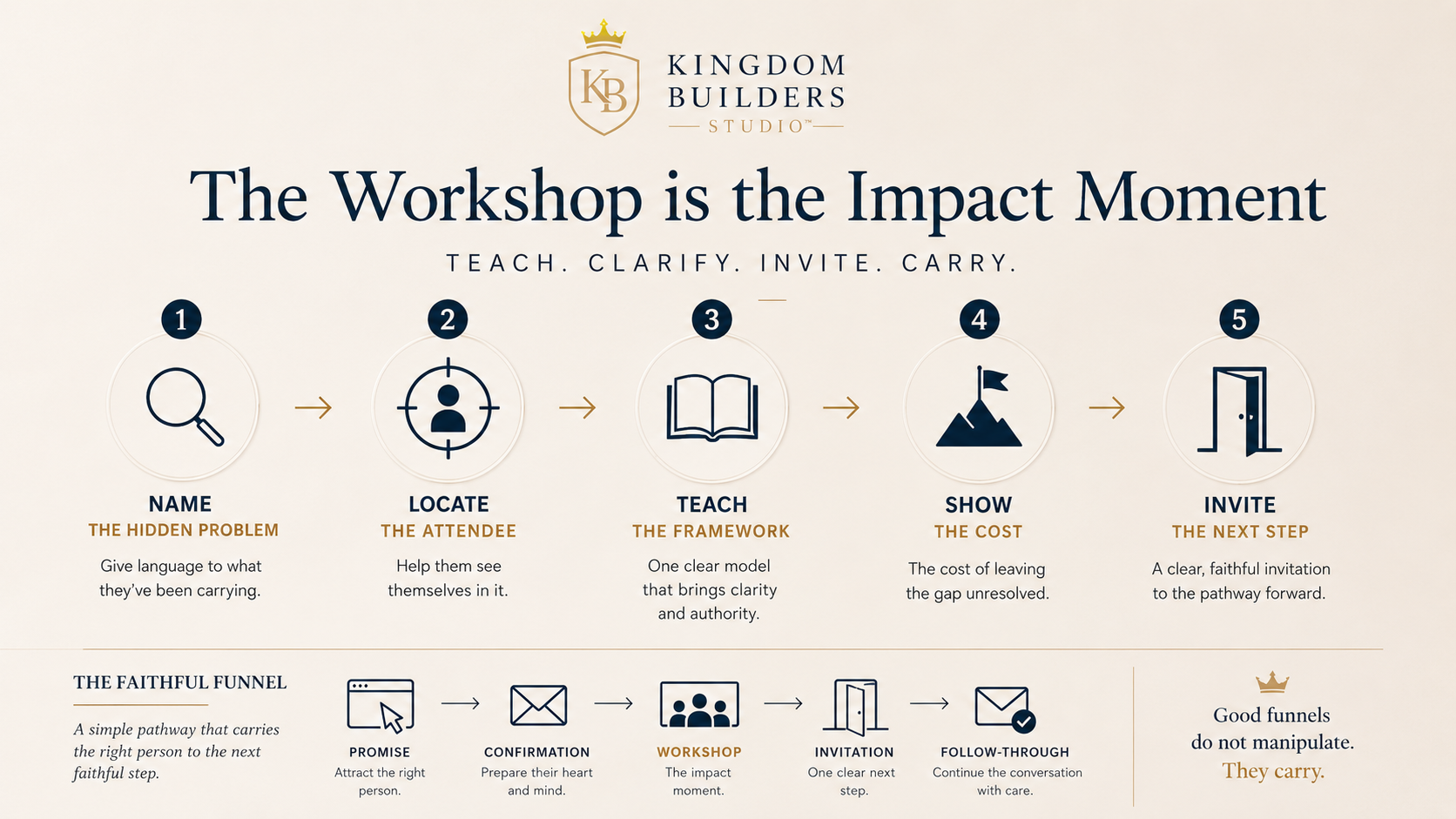
When I sit with Christian messengers in the Studio + Accelerator and we are mapping a workshop together, there are five movements I always make sure are in the room. They are not steps in a formula. They are pastoral and strategic responsibilities that together form an impact moment.
Name the hidden problem
A workshop does not start with the solution. It starts by giving the attendee language for what they have been carrying. The reason this matters so much is that most people in your audience can feel that something is unresolved, but they cannot yet articulate what it is. They reach for words, and the words they have are too shallow, too generic, or too borrowed from someone else's framework. Your first job, in the opening minutes of the workshop, is to give them a more accurate name for what they are experiencing. Once that name lands, the rest of the workshop has somewhere to go.
Locate the attendee inside the problem
There is a real difference between knowing a problem exists in the abstract and recognising yourself inside it. A good workshop closes that gap gently. You do this by describing the lived shape of the problem in enough specific detail that the attendee thinks, He is describing me. You are not trying to manipulate. You are simply being honest enough about the patterns you have seen that the attendee can locate themselves on the map. This is what allows what comes next to be received as personal teaching rather than general information.
Teach the governing framework
This is where authority forms. The framework is the one clear model that explains why the problem exists and what the pathway out of it looks like. Notice the restraint here. It is one framework, not ten. The temptation, especially for messengers who have been holding the same teaching for years, is to download everything they know. That actually weakens the workshop. What carries the attendee further into trust is not the volume of what you teach but the precision of what you teach. One framework, taught with real depth, lets the attendee feel that they are being given something usable rather than something overwhelming.
Show the cost of leaving the gap unresolved
I want to say this part carefully, because it is the place where workshops most easily slip into manipulation. The cost of leaving the gap unresolved is a real thing, and the attendee deserves to know it. If the messenger does not name the cost, they are actually withholding honest pastoral counsel. But the cost must be named in a way that is true and dignified, not exaggerated, not fear-mongered, not used as a lever. What I have come to learn is that when you describe the cost accurately — the unfinished book that stays unfinished, the sermons that never become a pathway, the message that never reaches the people it was sent to — the attendee feels seen, not pressured. The honesty itself is the conversion.
Invite the next faithful step
The fifth movement is the invitation, and this is where most workshops betray themselves. The invitation must feel like a continuation of the teaching, not a sudden tonal shift. If the room can feel the seams between teach and sell — if the energy changes, the language changes, the posture changes — the structure has failed. The attendee will trust you less after the invitation than they trusted you before it, and you will have undone the very thing the workshop was for.
A faithful invitation flows out of the teaching. It says, in effect: here is the problem we have named, here is the framework we have walked through, here is what it would look like to take the next step in your own work, and here is how I help people who are ready for that. There is no manufactured urgency. There is no trick. There is simply a clear pathway being placed in front of the people who, by this point in the room, already know whether it is for them.
Teaching alone does not create conversion. Pressure alone does not create trust. The workshop is the place where both are dignified at once.
05The funnel that should sit around the workshop
Now we come to the funnel. And what I want you to hear is that the funnel, in this framework, is not a separate thing from the workshop. It is the carriage that gets the right person into the room, holds them well while they are in it, and walks with them faithfully after they leave.
A simple, faithful workshop funnel has five pieces, and each one carries a particular pastoral weight.
The first is the promise, which is what the registration page actually does. The registration page is not there to hype the workshop. It is there to name the problem the workshop addresses, name the pathway it points to, and set a clear expectation of what the attendee will leave with. When the promise is honest and specific, the right person registers and the wrong person walks away — and both of those outcomes are good. PurposePages™ inside Kingdom Builders AI Studio™ is built specifically for this kind of page, so the messenger is not stuck wrestling with generic landing-page software that wants them to write like an internet marketer.
The second is the confirmation, which is the small sequence of emails that goes out between the moment of registration and the moment the attendee arrives. These emails are not there to hype either. They are there to deepen the language. Each one continues the conversation that the registration page started. Each one helps the attendee understand the problem more clearly so that, by the time they arrive in the room, they are already leaning in. The work that happens in those few emails is often the difference between an attendee who shows up cold and an attendee who shows up ready.
The third is the room itself. This is the workshop, structured as we walked through above. Name the problem, locate the attendee, teach the framework, show the cost, invite the step. The five movements are the architecture of the impact moment.
The fourth is the invitation, which sits inside the workshop but also outside it. The clearest pathway forward — one next step, named simply, with the right level of help for the readiness level of the room. For some attendees, the right next step is Kingdom Builders AI Studio™. For others, it is the Studio + Accelerator. For others, it is a Capital Conversion Call. For others, it is simply the next workshop in the sequence. The architecture you build should make it clear which step is right for which reader, rather than presenting one offer to everyone and hoping the right people self-select.
The fifth is the follow-through, which is the email sequence that continues the conversation after the workshop. This is the place most messengers either fall silent or fall into pressure. Both are mistakes. Silence assumes that everyone who was meant to act has already acted, which is not how serious decisions are made. Pressure betrays the trust the workshop just built. The faithful approach is a sequence that revisits the problem you named, addresses the real objections an honest reader would have, and makes the invitation again gently, leaving the door open for the reader to come back when their season is right. A good follow-up sequence is the email equivalent of a pastor who keeps the door open.
There is one more piece worth mentioning, and that is the diagnostic. A diagnostic can sit before the workshop, helping the right person decide whether this room is for them and routing the wrong person somewhere more useful. Or it can sit after the workshop, helping the attendee deepen the self-recognition the workshop began. Either placement strengthens the architecture. The Capital Conversion Gap™ Diagnostic is built to do exactly this kind of work — it helps the reader name where their spiritual capital is failing to become visible fruit, so the next step they take, workshop included, is the right one.
A good funnel does not manipulate. It carries people to the next faithful step.
06What goes wrong when the workshop and the funnel are built without conviction
I want to be honest about the failure patterns, because in serving Christian messengers I have seen the same five mistakes repeat themselves, and they almost always trace back not to a tactical error but to a conviction problem underneath.
The first failure is the teaching-heavy workshop with no real invitation. The messenger pours out everything they know, the attendee leaves grateful, and nothing changes. Grateful attendees who never move are not a sign of a faithful workshop. They are often a sign of a messenger who has not yet made peace with the fact that inviting someone into deeper help is itself a pastoral act.
The second failure is the invitation-heavy workshop with very little teaching. The attendee can feel within the first ten minutes that the whole event is engineered toward a pitch, and they spend the rest of the time with their guard up. This is what most believers fear when they hear the word funnel, and it is a real fear, because this kind of workshop really is being run.
The third failure is the registration page that promises transformation but the workshop that delivers content. The attendee registers expecting one thing and receives another. The damage to trust is enormous and often invisible to the messenger.
The fourth failure is the follow-up sequence that goes silent the moment the attendee does not buy on day one. The messenger interprets non-purchase as rejection and pulls away. What the attendee actually needed was a few more emails of careful continuation, and the door closed before they were ready to walk through it.
The fifth failure is the most subtle. It is the funnel built around the messenger's ego rather than the attendee's recognition. Everything is shaped around making the messenger look impressive rather than around helping the attendee see themselves clearly. The attendee can feel this even when they cannot articulate it.
In nearly every case, what looks like a conversion problem is actually a conviction problem. The architecture reveals what the messenger truly believes about the people they are serving. When the conviction is right — when the messenger genuinely believes their job is to clarify, to dignify, and to invite — the structure almost builds itself.
07Why this matters for the way you think about your message
I want to bring this back to the Capital Conversion Gap™, because the workshop is not just a tactic. It is one of the most practical ways to close the gap that I keep seeing in the lives of serious Christian messengers.
You may have decades of accumulated spiritual capital. Sermons, frameworks, lived experience, professional expertise, hard-won ministry insight. None of that is in question. What is often missing is the architecture that converts that capital into visible Kingdom fruit. And the reason the workshop is so important is that it is the place where capital becomes encounter, and encounter becomes pathway.
The workshop is not the only piece of conversion architecture you need, but it is one of the most powerful, because it does several things at once. It clarifies your message in your own mind. It clarifies the problem you are serving in the attendee's mind. It builds trust faster than almost any other format. It qualifies the right reader without pressure. And it makes the next step visible, both to you and to the people God sent you to serve.
If you do not yet have a workshop in your conversion architecture, what I would encourage you to take seriously is this: the gap between what you carry and what is reaching the people you are sent to serve may not be a content problem, a visibility problem, or even a marketing problem. It may be the absence of an impact moment. And the workshop is the most faithful, most repeatable, most pastorally honest impact moment a Christian messenger can build.
08A faithful next step
If what you have read here has named something you have been sensing, the most useful thing you can do is not read another article. It is to sit in a workshop that is built this way, and let it teach you from the inside.
The next Kingdom Builders workshop is open for registration now. I run these myself, and they are built on exactly the architecture this article describes. You will not just hear about the impact moment. You will be inside one. That alone will teach you more about what your own workshop should look like than any framework I could put on a page.
If you suspect that something earlier in the chain is unresolved — that you have not yet clearly named the gap between what you carry and what is reaching people — start with the Capital Conversion Gap™ Diagnostic. It will give you a more honest map of where to build first.
And if you are already building, and you know you need implementation help rather than another framework, a Capital Conversion Call is the right next step. We can look together at what you are carrying, where the gap is, and what the most faithful next move would be.
The aim is not to add another item to your business. The aim is to give what God placed in your hands a structure that can actually carry it to the people it was sent to.
09Frequently asked questions
What makes a workshop different from a webinar?
A webinar, in most current usage, is built around a sales pitch and structured to lead inevitably to a buying decision. A workshop is built around teaching that genuinely transforms how the attendee understands their problem, with an honest invitation at the end. The attendee leaves a webinar feeling pitched. The attendee leaves a faithful workshop feeling clarified, whether or not they take the next step.
How long should a Christian workshop be?
Long enough to name the problem, locate the attendee, teach one governing framework, show the cost, and make the invitation. For most messengers, that lands somewhere between 60 and 90 minutes. Shorter than that and you do not have time to do the framework justice. Longer than that and attention begins to fall, which weakens the recognition the room was built to create.
Do I need to be selling something to run a workshop?
You do not need a paid offer at the end to run a workshop, but you do need a clear next step. The next step might be a paid programme, a free diagnostic, a follow-up workshop, or a Capital Conversion Call. What matters is that the attendee leaves the room knowing exactly what to do with what they just learned. A workshop without a next step is a teaching event, which has its own value, but it is not yet a conversion structure.
What should happen between someone registering and the workshop?
A short sequence of emails that continues the conversation. Two to four messages is usually enough. Each one should deepen the attendee's understanding of the problem the workshop addresses, not hype the event itself. The aim is that by the time the attendee arrives in the room, they are already leaning in, already thinking in the categories the workshop will teach.
Is it ethical to invite people to a paid offer at the end of a free workshop?
Yes, when the invitation is honest, the offer is genuinely the right next step for the right attendee, and the workshop has delivered real teaching rather than being a thinly disguised pitch. The ethical question is not whether you invite. It is whether the invitation flows out of teaching that has already served the attendee, and whether the offer is sized appropriately to the recognition the workshop has produced. Invitation, done rightly, is itself a pastoral act.
About the author
Dr Uche Okere
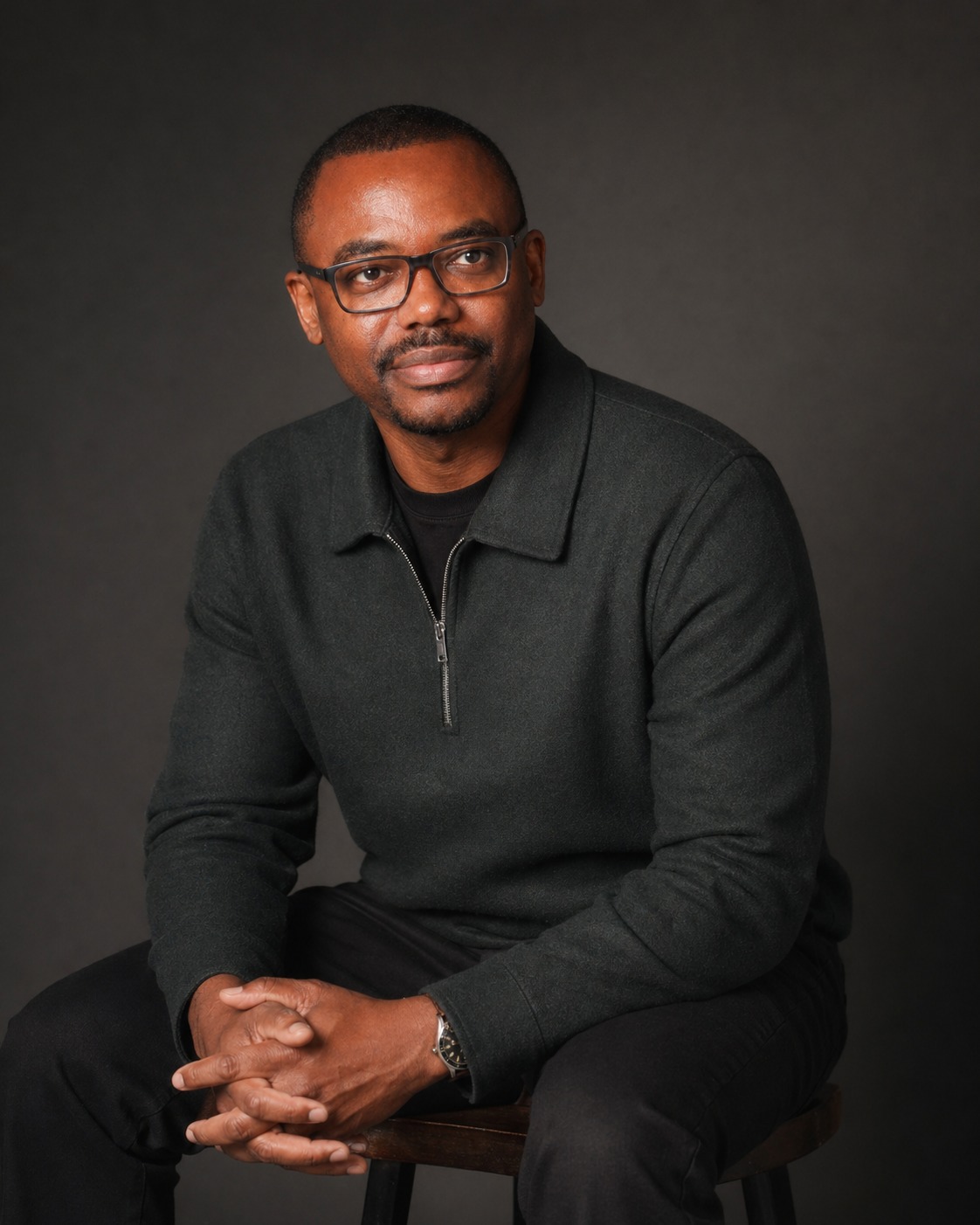
Dr Uche Okere is a pastor, university academic, coach and founder of Kingdom Builders AI Studio. He helps pastors, authors, speakers and faith-driven builders convert spiritual capital into visible Kingdom impact through message architecture, AI tools, workshops and practical implementation.
Explore the Studio