TL;DR
- You carry a real message.
- But a sincere message without structure rarely serves the people it was given for.
- This article explains what Message-to-Market Architecture is, why it matters, and how to close the gap between what you carry and what people can actually receive.
In this article
- 01Your message is not the problem. Your architecture is.
- 02What is the difference between a message and a pathway?
- 03Why sincerity is not enough
- 04The five stages of Message-to-Market Architecture
- 05Where the breakdown usually is
- 06What Message-to-Market Architecture is not
- 07A word about the messengers who resist structure
- 08The next step
- 09Frequently asked questions
01Your message is not the problem. Your architecture is.
There is a kind of believer I sit with regularly in my work — a pastor, a Christian author, a coach, a speaker, a ministry leader, someone who has been walking with God for years, sometimes decades. They have preached, taught, written, prayed, served, and believed. The weight of what they carry is not in question. Anyone who spends an hour with them can feel the substance. And yet, for reasons they struggle to name, none of it has quite translated. The message is real. The calling is genuine. But something between the interior and the visible has broken down, in the sense that what they carry and what people can actually receive feel like two different things.
When I sit with these believers and work through what has happened, I have come to learn that the problem is rarely what they assume it to be. It is not a lack of anointing. It is not a lack of content. It is not a marketing problem, at least not in the way the word marketing is usually understood. What I see, consistently, is something more structural. The message has not yet become a pathway.
That distinction matters more than most people think, and it is where I want to begin.
02What is the difference between a message and a pathway?
A message is what you carry. It is the deposit — the burden, the revelation, the lived experience, the framework that has formed in you through years of faithfulness, suffering, ministry, and work. A message is real. It is yours. It belongs to you in the sense that it arose from your particular journey with God and your particular calling toward a particular people.
A pathway is what other people can walk. It is the structure that takes a message from something you carry privately to something another person can receive, understand, apply, and benefit from. The pathway is not about dimming the message. It is about translating it into a form that can actually serve the person it was given for.
Here is the reason this distinction matters. You can carry a completely genuine message and still fail to serve the people it was meant to reach — not because your message is weak, but because the message was never built into a route anyone could follow. I have come to think of this as the architecture problem, and it is one of the most common causes of the Capital Conversion Gap™ I see among Christian messengers.
The person preaches year after year, but the sermon stays in the building. The author publishes, but the book sits on a shelf rather than opening a door. The coach explains the framework in session after session, but the transformation never quite compounds in a way that builds either a discipleship pathway or sustainable income. The message is real. The architecture is missing.
03Why sincerity is not enough
One of the harder truths I have had to learn, and to say clearly when I serve pastors and Christian authors, is that sincerity does not convert a message into a pathway. It does not make the message more accessible. It does not help the person on the other side of your book or sermon or workshop understand where they stand, what they need, or what their next step is.
What happens, in the absence of architecture, is that sincere messages often remain exactly where they started — beautiful, real, and enclosed. The revelation does not travel. The sermon archive grows but never multiplies. The book gets written but never quite becomes the door it was meant to be. The coaching offer exists but is never quite clear enough to attract the people it was built to serve.
I want to be careful here because I am not suggesting that spiritual work should be reduced to a sales funnel. That framing would be unfaithful to the kind of work I believe God is calling His messengers to do. What I am saying is something more careful than that. A message that cannot be received by the person it was given for is not serving them, regardless of how sincere the messenger is. Structure is not the enemy of spiritual depth. It is, in the right framing, a form of pastoral care.
When you build the architecture that turns your message into a pathway, you are not commercialising something sacred. You are honouring the people your message was given for by making sure it can actually reach them.
04The five stages of Message-to-Market Architecture
The framework I use in my work with messengers, authors, and ministry leaders is a five-stage movement. It is not a rigid template. It is a diagnostic architecture, in the sense that you can look at any messenger's situation and identify exactly where the breakdown is occurring. Some people have a clear message but no framework. Some have a framework but no delivery vehicle. Some have a product but no impact moment. Understanding which stage is missing or underdeveloped is often the beginning of the real work.
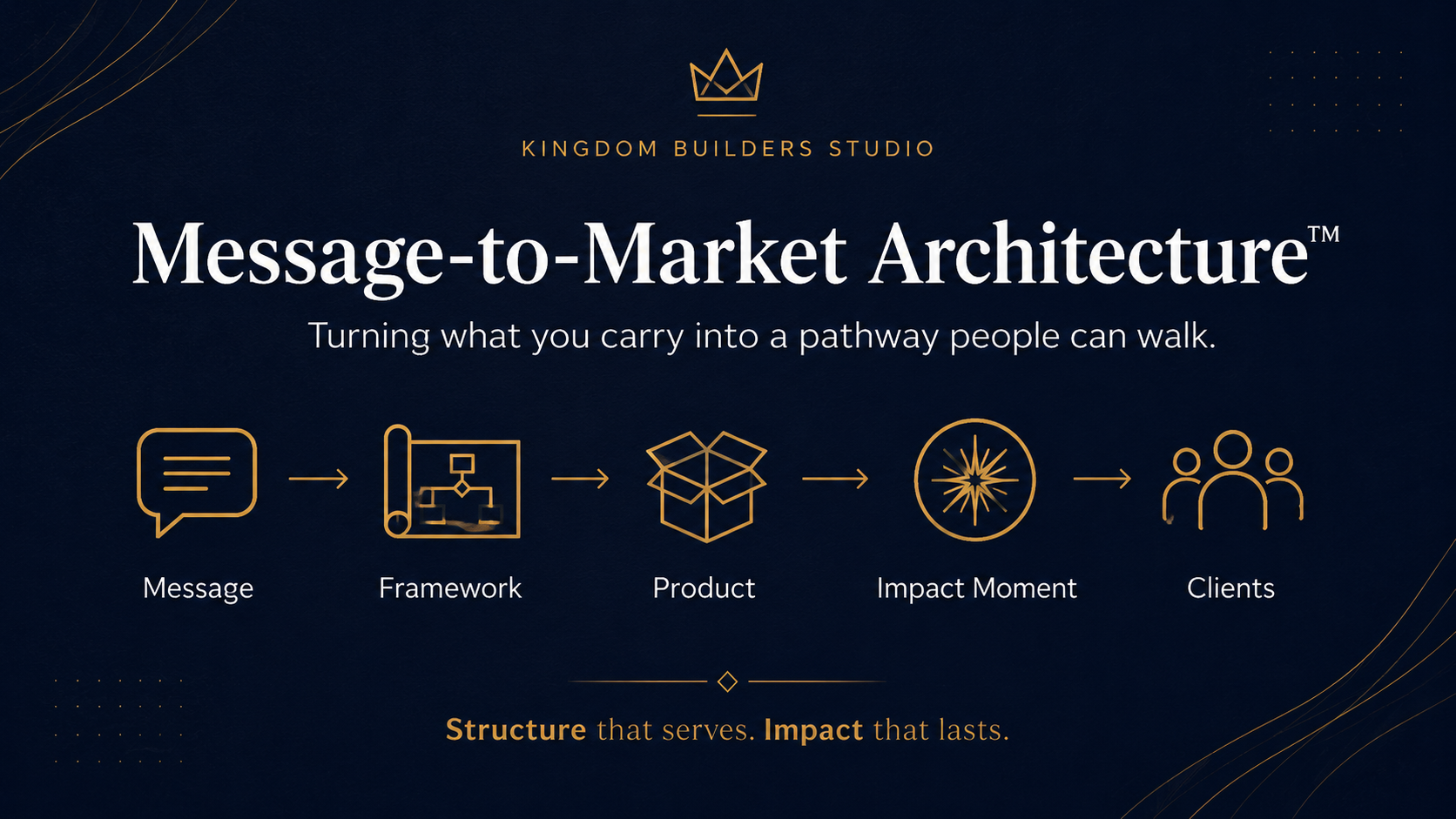
The five stages move in this sequence:
Message → Framework → Product → Impact Moment → Clients
Let me explain what each stage actually means.
Stage 1: Message — what has God entrusted to you?
The message is the divine deposit. It is the revelation, the burden, the lived experience, the testimony, the theological clarity, the area of mastery that you carry. It is what God has placed in you through years of faithfulness, study, prayer, suffering, ministry, and obedience.
But the message at this stage is often still interior. It may be scattered across years of sermon notes, journal entries, coaching conversations, teaching outlines, and half-written books. It is real, but it has not yet been clarified into something another person can see clearly enough to recognise as relevant to their own situation.
The work of Stage 1 is clarity. Not simplification in the sense of making the message smaller, but precision — finding the thread that runs through everything you carry, naming the burden in a way that makes sense to someone outside your own experience, and identifying the people the message was formed to serve.
The clarifying question at this stage is this: What has God entrusted to me that I am responsible to steward for the benefit of others?
Stage 2: Framework — turning revelation into structure
This is one of the most important and least understood stages. A framework is where raw message becomes structured revelation. It is the repeatable pathway, the method, the process, the model that takes a person from where they are to where the message is pointing them.
The reason frameworks matter is not that they make things look professional. The reason is much more practical than that. People do not take action — they do not invest time, trust, money, or attention — simply because something is inspiring. They move when they can see a clear pathway from their current pain to a real transformation. The framework is what makes that pathway visible, teachable, usable, and repeatable.
I have come to learn that this is where many messengers stall. They have years of content but no through-line. They have deep knowledge but it is not yet structured in a way that another person can walk through. What I often see is that the framework exists implicitly — it is operating in their teaching and their coaching — but it has never been made explicit. And an implicit framework cannot be packaged, taught, priced, or scaled. It cannot become a book chapter, a workshop agenda, or a course curriculum. It can only live inside the messenger's head, which means the only way to access it is to be in the room with that person.
The work of Stage 2 is structure — making the implicit explicit, building the visible scaffold that turns your message into something transferable.
Stage 3: Product — the stewardship container
Once the framework is clear, the question becomes how it should be packaged so it can serve the people it was built for. The product is the delivery vehicle. It could be a book, a course, a workshop, a coaching programme, a membership, a group programme, a diagnostic, a digital tool, a mentorship pathway, or some combination of these.
The question that governs Stage 3 is not how do I monetise this? It is more faithful than that. The question is: How should this message be packaged so it can actually serve people, create transformation, and sustain the mission?
I want to hold on to that framing because it changes how the product gets built. When the product is treated purely as a revenue mechanism, it tends to be built backward from a price point or a marketing funnel. When it is treated as a stewardship container — as the most appropriate vessel for the message to travel in — it tends to be built forward from the people it was designed to serve and the transformation it was designed to produce.
There is nothing unspiritual about a book, a workshop, a course, or a coaching offer. These are not compromises. They are, when built faithfully, the most practical expression of the belief that the message was given for others, not only for the messenger.
Stage 4: Impact moment — where the message meets the person
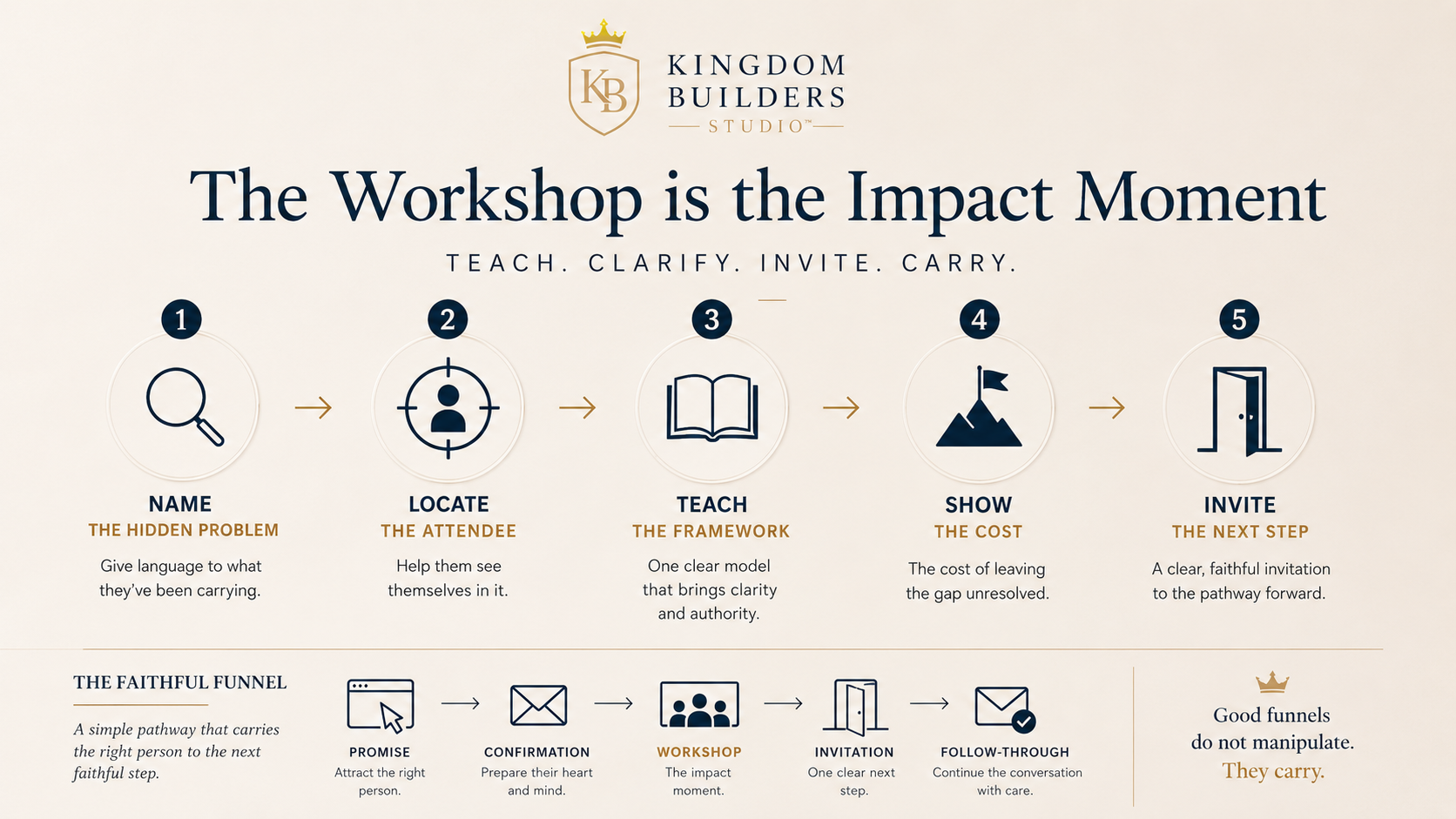
This is the live or high-trust event where another person encounters the message, sees the framework, recognises its relevance to their own situation, and understands what their next step is. The impact moment is where the architecture becomes real in someone else's life.
A workshop is an impact moment. A keynote talk is an impact moment. A well-crafted free training, a diagnostic tool, a webinar, an introductory programme — these are all, in their different forms, impact moments. What they share is that they allow a real person to experience the message rather than simply hear about it.
The reason impact moments matter so much is that trust does not transfer from content alone. A person does not become a client, a discipleship partner, or a committed reader because they read a sales page. They take the next step because, at some point, they encountered the message in a form that was real enough to help them see their own situation differently. That encounter is the impact moment.
The work of Stage 4 is trust — creating a space where the message can be experienced, not just described.
Stage 5: Clients — the ethical pathway deeper
The word clients sometimes makes Christian messengers uncomfortable, and I understand why. The associations can sound more transactional than pastoral. But I have come to think of this stage not as a commercial endpoint but as an ethical next step — the route for people who have encountered the message, recognised its relevance, and now need deeper support to walk through the transformation it points toward.
A client, in this sense, is a person who has decided that the message speaks to their real situation and who needs more than a book or a workshop can provide. The client pathway — whether it leads into a coaching programme, a Studio membership, an accelerator, a mentorship relationship, or deeper group work — is not a sales move. It is a pastoral provision. It is the answer to the question: For the person who is genuinely ready to work at depth, what is the next responsible place to go?
When this stage is missing, two things tend to happen. Either the messenger has no revenue pathway, which means the mission cannot be sustained, or the person in need of deeper support has nowhere to go after the initial encounter, which means the transformation stalls at inspiration rather than completing at change.
05Where the breakdown usually is
When I work with pastors, authors, coaches, and ministry leaders through this architecture, I have come to find that most people are not missing the whole framework. What happens is they are missing one or two critical stages, and those gaps are creating the breakdown in conversion.
The pastor with years of sermons often has a clear message but no framework. The teaching is strong but it is not yet structured into a route someone can follow outside of Sunday morning. The result is that the message serves the congregation in the room, but it does not travel. The archive grows, but the fruit does not multiply.
The Christian author often has a message and, implicitly, a framework. But the product — the book itself — was built as a destination rather than a door. The book was meant to change lives, but it was not built to lead the reader anywhere after they finished reading. There is no impact moment connected to it, no pathway deeper, no invitation that feels organic and earned. The result is that the book sits well but does not convert into the relationship, the service, or the income that would allow the author to keep writing and serving.
The coach or speaker often has all of the above — message, framework, even a product — but the impact moment is missing or underdeveloped. They are explaining the transformation in conversations and sessions, but there is no structured event where a broader group of people can encounter the message and see the pathway clearly enough to take a next step. The result is that growth feels slow, referral-dependent, and hard to scale.
Understanding which stage is underdeveloped is often the most valuable diagnostic work I do with someone.
06What Message-to-Market Architecture is not
I want to be clear about what this framework does not mean, because the language can be misread.
Message-to-Market Architecture is not a formula for commercialising spiritual content. It is not a technique for making sacred things sound marketable. It is not a system for building a personal brand at the expense of a genuine calling. And it is certainly not a shortcut for people who have not yet done the formation work of carrying a real message.
What it is, in the sense that I have come to understand it, is a stewardship pathway. It is the architecture that helps a messenger take what God has placed in them — the deposit, the revelation, the lived experience, the framework — and build the structure through which it can actually serve the people it was given for. It is how faithful discipleship and faithful deployment get connected.
The ordering matters. Kingdom impact comes first. Conversion architecture is how that impact travels. Income and clients are necessary infrastructure, not the highest aim. When this ordering is preserved, Message-to-Market Architecture feels less like a marketing strategy and more like an act of faithfulness.
07A word about the messengers who resist structure
I serve some believers who are instinctively resistant to the language of architecture and market and pathway. They are not being difficult. What they are often doing is protecting something real — the conviction that their message is not primarily a product, that their calling cannot be reduced to a funnel, and that something would be lost if the sacred content of an ministry got handed over to a system that cared more about conversion rates than souls.
Those instincts are worth honouring. I honour them in my own work. But I have also come to see that there is a cost to resisting structure altogether. The person whose message remains only interior, only oral, only confined to a single room or a single moment — that person is not protecting the message. They are limiting it. The revelation that never becomes a book does not reach the person who cannot be in the room. The framework that never becomes a structured pathway cannot serve the person who does not yet have language for their own problem.
There is a faithful version of architecture. It begins from the message, not from the market. It asks, what is the most faithful form for this message to take so it can serve the people it was given for? And it builds from there — one stage at a time, with clarity about what each stage is for.
That is the version of Message-to-Market Architecture I teach, and it is what the Kingdom Builders AI Studio™ is built to support.
08The next step
If what you have read here names something you have been feeling but struggling to locate — a sense that your message is real but not yet travelling, that your book or sermon or framework is sincere but not yet structured into a route people can follow — the most useful next step is to diagnose where the breakdown is.
The Capital Conversion Gap™ Diagnostic will help you do that. It is designed for exactly this situation — for the person who carries genuine spiritual and created capital but has not yet built the architecture to convert it into visible Kingdom fruit. You can take it at capitalconversiongap.com.
If you are at a place where you are ready to build the architecture around your message — to take what you carry through the five stages of the Message-to-Market Blueprint™ — the next Kingdom Builders Workshop is the right place to begin. You will find the details and registration at kingdombuilders.studio/workshop.
And if you are carrying a book in progress, a sermon archive, or a framework that is not yet structured into a pathway people can walk, the Message-to-Book Builder™ was built precisely for that work. You can find it at kingdombuilders.studio/book.
The message you carry was given for others. The architecture is how you honour them with it.
09Frequently asked questions
What is Message-to-Market Architecture?
Message-to-Market Architecture is a framework developed by Dr. Uche Okere for helping Christian messengers — pastors, authors, coaches, speakers, and ministry leaders — turn a God-given message into a structured pathway that other people can understand, trust, and walk. It follows a five-stage movement: Message → Framework → Product → Impact Moment → Clients.
Is Message-to-Market Architecture just marketing for Christians?
No. It is a stewardship framework, not a marketing methodology. Its purpose is to help messengers take what God has placed in them and build the structure through which it can faithfully serve the people it was given for. The ordering is always Kingdom impact first, conversion architecture second, income and clients as necessary infrastructure.
What is the difference between a message and a pathway?
A message is what you carry — the revelation, the burden, the framework, the lived experience. A pathway is what another person can walk. A sincere message without architecture rarely serves the people it was given for, not because the message lacks value, but because it has not yet been translated into a form the person on the other side can receive, follow, and benefit from.
Who is this framework for?
It is designed for Christian pastors, authors, coaches, speakers, and purpose-driven professionals who carry genuine spiritual capital but have not yet built the architecture to convert it into visible Kingdom fruit. It is particularly useful for those with sermon archives, published or unpublished books, coaching frameworks, or ministry experience that has not yet become a structured pathway.
What is the first step if I want to apply this framework?
The most useful starting point is to diagnose where the breakdown is occurring in your own situation. The Capital Conversion Gap™ Diagnostic at capitalconversiongap.com is designed to help you locate exactly which stage of the architecture is underdeveloped. From there, the next Kingdom Builders Workshop will give you the practical tools to begin building.
What is the Capital Conversion Gap™?
The Capital Conversion Gap™ is the governing diagnostic framework behind all of Dr. Uche Okere's work. It names the distance between the spiritual capital a believer has accumulated and the tangible Kingdom outcomes they are currently producing. The gap is not a faith deficiency. It is an architectural one — caused by missing structure, not missing calling. Message-to-Market Architecture is one of the primary pathways for closing it.
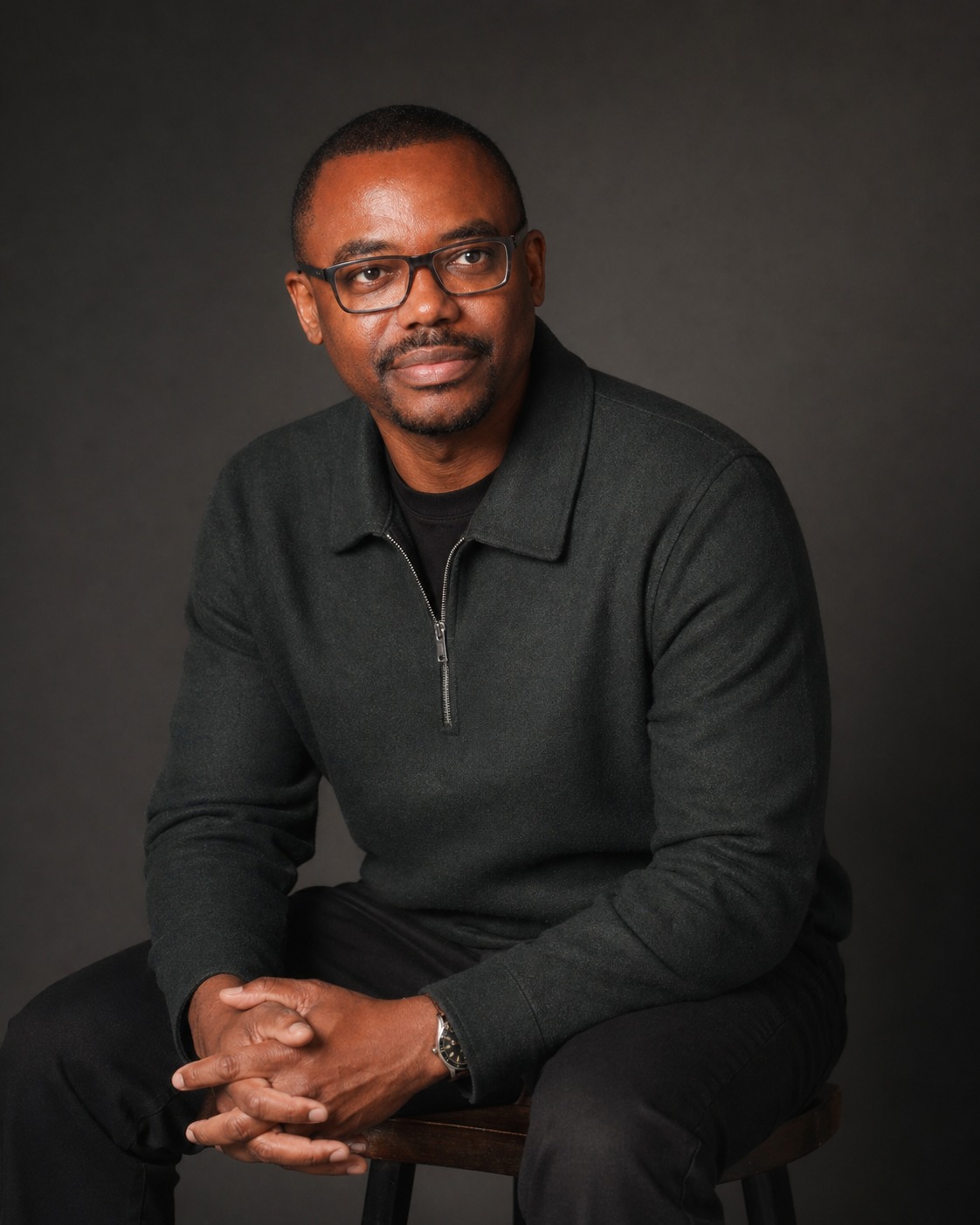
About the author
Dr Uche Okere
Dr Uche Okere is a pastor, university academic, coach and founder of Kingdom Builders AI Studio. He helps pastors, authors, speakers and faith-driven builders convert spiritual capital into visible Kingdom impact through message architecture, AI tools, workshops and practical implementation.
Explore the Studio