TL;DR
- A widespread but unbiblical belief suggests it's unholy to receive financial fruit from spiritual gifting.
- This idea, rooted in Greek dualism rather than Scripture, is hampering the Kingdom's financial capacity by conditioning faithful believers to refuse the very mechanism of provision that would resource their mission.
- This article dismantles the false dichotomy and presents a biblical case for faithful stewardship that includes receiving provision for spiritual labor.
In this article
There is a belief that lives in the conscience of sincere, faithful believers, and it is one of the most quietly consequential beliefs in the modern Church. It does not announce itself. It does not usually get preached from a pulpit. It operates more like an atmosphere than a doctrine — a low-grade sense that when spiritual gifting and financial fruit appear in the same sentence, something has gone slightly wrong. That the person who desires to receive provision from their calling is, at some level, compromising. That the truly holy response to gifting is to deploy it freely, sacrificially, and without expectation of material return.
I have sat with enough pastors, Christian authors, coaches, and purpose-driven professionals to know that this belief is widespread, that it feels genuinely holy to the people who carry it, and that it is doing measurable damage to the Kingdom's financial capacity. The people most likely to fund global mission, plant churches, build schools, support families in their congregation, and resource movements they believe in are often the exact people who have been most conditioned to refuse the mechanism that would make all of that possible.
This article examines where that belief came from, tests it against the full weight of Scripture, and makes the case that what looks like humility is often something closer to a theological error — one with real consequences, and one the Church has rarely named clearly enough to correct.
01Where the belief came from — and why it feels so holy
To understand why so many believers carry this conviction, you have to understand where it originated, because it did not originate in the Bible.
The feeling that spiritual things and material things occupy separate moral categories — that the soul is pure and the body is suspect, that ministry is sacred and commerce is secular — is largely a product of Greek philosophical thought, specifically the kind associated with Platonic dualism, which entered Christian culture gradually across the early centuries of the Church. In its most basic form, this way of thinking treats the spiritual and the material as inherently opposed, with the spiritual carrying moral superiority and the material carrying moral risk. The soul strains upward toward the divine. The body, and everything associated with it — including money, commerce, and material exchange — pulls downward toward corruption.
This framework was never the biblical one. But it was intellectually sophisticated, it was widespread in the Greco-Roman world into which the early Church expanded, and it was genuinely seductive to believers who were trying to hold the gospel apart from the excesses of Roman commercial culture. And so over time, without it ever being formally voted in, a way of thinking that originated in Athens began shaping how the Church in Antioch, Rome, Carthage, and eventually every subsequent generation understood the relationship between holiness and material life.
The reason this matters so much is that Jewish thought, which is the soil in which the entire New Testament grew, held no such division. In the Hebrew understanding of the world, creation is good because God made it, and the goodness of creation was not undone by the fall — it was subjected to futility, as Paul writes in Romans 8, but it groans toward redemption, not toward disposal. Matter matters. The body is not a prison for the soul; it is the place where obedience actually occurs. Work is not a distraction from worship; it is itself a form of worship when rightly oriented. This is why the Law of Moses spends as much time on honest weights and fair wages as it does on Sabbath observance — because in the biblical worldview, faithfulness in material life is an expression of faithfulness to God, not a departure from it. The two were never meant to be separated.
What I have come to learn, sitting with believers across many contexts, is that the Greek version of this idea did not arrive in the Church like a hostile invader. It arrived like a well-dressed guest who seemed to share the same values, and it stayed because no one pressed it hard enough on its biblical credentials. It felt right. It sounded humble. It appeared to protect the gospel from exactly the kind of commercialisation that every generation of believers has, rightly, been wary of.
The Platonic version crept in with the best of intentions. Sincere believers in every generation have worried, rightly, about the corruption of ministry by financial motivation. History gives them reason to worry. There are real examples of gifted people whose anointing became a commercial operation, whose calling became a commodity, whose ministry became unrecognisable under the pressure of financial incentive. The concern is not irrational. I share it. The theological guardrail against the corruption of ministry by financial ambition is real, and it needs to be in place.
But what has happened in the Church is that a legitimate caution has been pushed far past its biblical warrant, to the point where it has become a blanket suspicion of material fruit from spiritual work. And the problem with a blanket is that it covers everything — the abuses it was meant to guard against, yes, but also the faithful stewardship it was never meant to touch. The believer who receives provision for genuine Kingdom labour is not in the same category as the one who exploits spiritual authority for personal gain. Treating them as though they are produces a theology that cannot be sustained from the text.
02What the Bible actually says
The biblical case here is stronger than most people in this conversation realise, and I think it deserves to be stated plainly.
Paul, writing to the Corinthians, states: "The Lord commanded that those who proclaim the gospel should get their living by the gospel" (1 Corinthians 9
). This is not Paul's opinion or a pastoral suggestion. He frames it as a command — the Lord's command — that those who labour in the proclamation of truth should receive material provision from that labour. He draws the analogy from farming and soldiering: no one plants a vineyard and expects nothing from it. No soldier goes to war at his own expense. The pattern of labour and provision is built into the creation order, and Paul applies it to spiritual labour as directly as to any other kind.Luke 10
, where Jesus sends out the seventy-two, contains the phrase Paul quotes in that same passage: "the labourer is worthy of his wages." Jesus said it. Paul applied it. It is in the text.1 Timothy 5
–18 extends this logic to elders who labour in preaching and teaching, saying they are worthy of double honour — and the context makes clear that material provision is explicitly what "honour" includes.These are not obscure passages. They are direct, clear, and apparently ignored by a significant portion of the Church's practical theology around gifting and provision.
The most illuminating example in all of Scripture on this subject, though — and the one I return to most often when I sit with believers struggling with this particular tension — is not in the New Testament at all. It is in 1 Kings, in the account of Solomon.
When God deposited wisdom in Solomon (1 Kings 3
), Solomon did not sit on the deposit. He converted it into created works: three thousand proverbs, one thousand and five songs, along with a comprehensive body of teaching across natural history, governance, and relational wisdom (1 Kings 4–32). Those created works travelled beyond his personal presence. People came from all the surrounding nations to access them. And then the Queen of Sheba arrived from her nation specifically to engage with what she had heard about — and she came carrying spices, precious stones, and 120 talents of gold (1 Kings 10–10).The biblical narrative does not present this exchange as a contamination of the ministry. It presents it as evidence of the quality and value of what had been built and made accessible. The created works generated reputation. The reputation generated the transaction. The transaction was real and substantial. And after receiving Solomon's wisdom and completing the exchange, the Queen of Sheba left saying: "Praise be to the Lord your God, who has delighted in you and placed you on the throne of Israel."
She came for wisdom. She paid for wisdom. She left praising God.
The material exchange did not corrupt the Kingdom outcome. It was part of the same transaction.
What this tells me — and what the New Testament passages confirm — is that the language of deposit, provision, and material exchange applied to spiritual labour is not an imposition on the gospel by the marketplace. It is the Bible's own language. Recovering it does not commercialise the faith. It restores a biblical category the modern Church has quietly abandoned.
03The distinction that changes everything
There is a real concern underneath the false belief, and it deserves to be honoured rather than dismissed.
The concern is that financial motivation will corrupt the purity of the ministry. And as I noted, it is not without historical warrant. The Solomon narrative itself carries this warning in its final arc. The same man who produced three thousand proverbs eventually accumulated seven hundred wives and three hundred concubines and turned to other gods. Ecclesiastes — itself a created work — is one of the most searching assessments of what accumulated achievement produces when it becomes untethered from the God who made the original deposit. "Vanity of vanities." Created works are capital in service of the King, never ends in themselves. The moment they begin to serve the creator's reputation rather than the King's purposes, the trajectory moves from Solomon's triumph toward Solomon's tragedy.
So the caution is not wrong. What is wrong is where it has been placed.
The distinction that most of this conversation has been missing is the difference between provision as the outcome of faithful stewardship and provision as the motive that drives the work. These are genuinely different things, and collapsing them is exactly how the theological error forms.
When a pastor structures a lifetime of sermons into a book — not primarily to sell the book, but because the revelation in those sermons deserves a form that outlives any single Sunday morning — and when that book then provides income that funds continued ministry, supports a family, and releases capacity for further work, what has happened is not compromise. What has happened is stewardship producing its natural fruit.
The biblical test is not "did this produce income?" It is closer to what Jesus describes in Matthew 6: where is your treasure? What is your heart actually oriented toward? Is the Kingdom the goal and provision the means, or has that order quietly reversed? The reversal is the corruption. The provision itself, in its proper place, is not only permitted — it is the pattern Scripture establishes across both Testaments.
04What this is actually costing the Kingdom
There is something that rarely gets named in this conversation, and it deserves to be named plainly.
The people most capable of funding Kingdom mission at scale are often the very people most conditioned by this false belief. The pastor with thirty years of accumulated revelation who never built a form from it — not because he lacked the gifting or the material, but because something in his theology made the idea of receiving provision for that revelation feel slightly dishonourable. The Christian professional whose vocational mastery, structured into a coaching practice, could have supported her family and funded three mission trips a year and still had capacity left — but who kept the wisdom in her head and her bank account in deficit because she had never been taught a biblical framework for the exchange. The author whose book never became a pathway because she felt uncomfortable attaching an invitation to the back of it, as though asking the reader to take a next step was somehow a betrayal of the purity of what she had written. The speaker whose message never became a course because the idea of receiving provision for revelation felt uncomfortably close to selling the gospel — a line she was determined not to cross, without ever having been shown where that line actually is.
I sit with these believers regularly, and what I notice is that the cost is not only financial, though the financial cost is real and significant. What also drains away is reach. The people who needed the specific wisdom this specific messenger carried — and who would have been willing to pay appropriately for access to it, in exactly the way the nations paid appropriately for access to Solomon's — never find it, because it was never made findable. The ministry that would have been funded by that provision never gets resourced. The next generation that would have been shaped by that teaching never encounters it in a form they can receive and pass on.
What happens, in other words, is that the Kingdom's capacity — financial, ministerial, generational — drains away not because believers are unfaithful in their hearts, but because they were given a theological error in place of theological clarity. They were taught to refuse the mechanism of release. And the mission that needed funding, the people who needed the service, the communities that needed the transformation — all of them waited for resources that were sitting one conversion step away from being deployed.
There is a particular irony here that I find genuinely painful. The believers who most vigorously avoid any appearance of financial motivation in their ministry are often the same believers whose ministries are most under-resourced, whose families carry the most financial strain, and whose Kingdom impact — which they care about deeply — is most constrained by the lack of infrastructure that appropriate provision would have funded. The refusal of the mechanism does not produce holiness. It produces limitation. And the limitation is not borne only by the messenger — it is borne by everyone the messenger was assigned to reach.
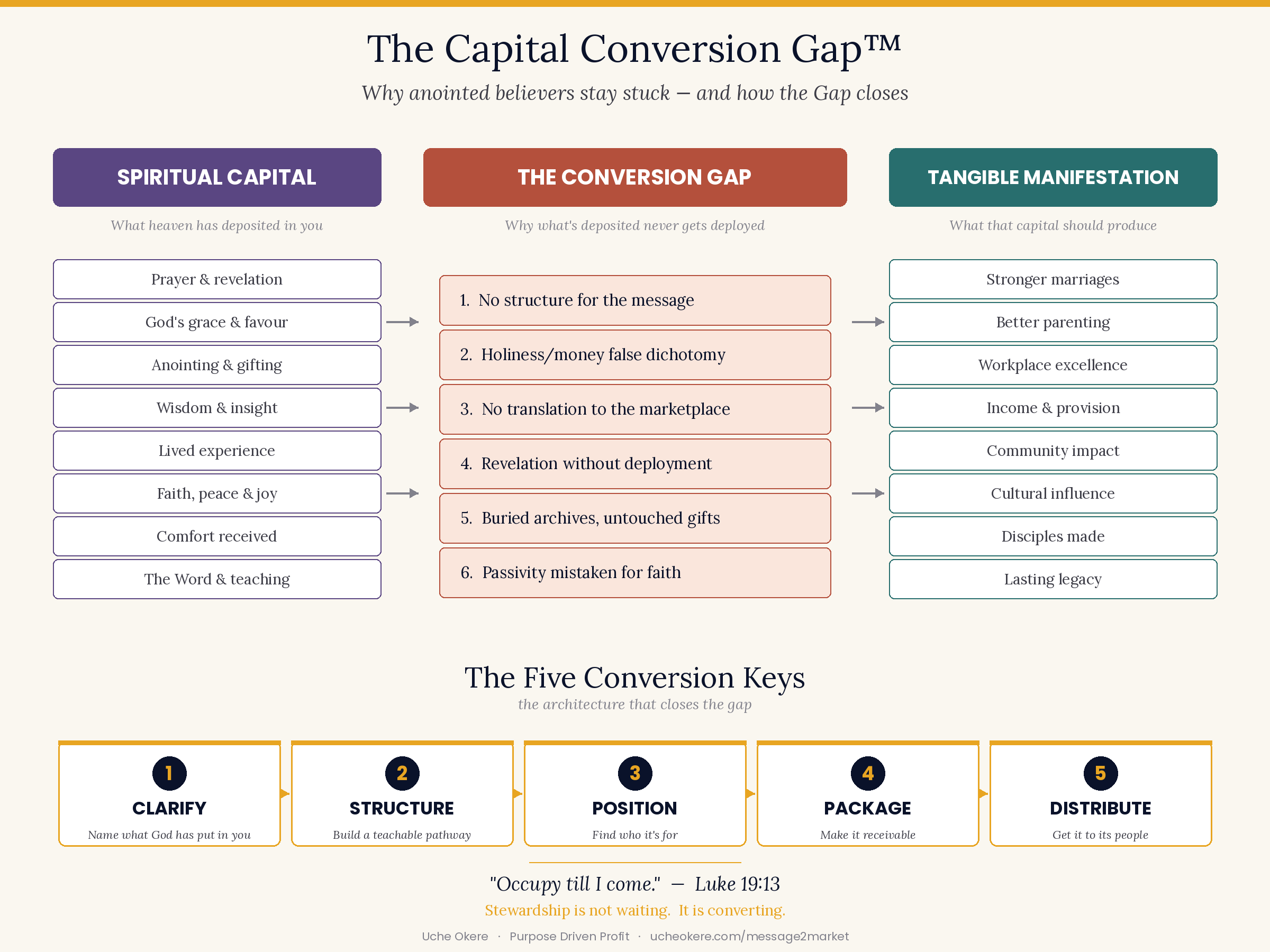
The issue, as I frame it within the Capital Conversion Gap™, is not one of faith or anointing. It is one of architecture. And one of the most load-bearing pieces of that architecture is the theology that either frees the believer to convert their spiritual capital into tangible fruit — including financial fruit — or keeps them locked in a kind of pious paralysis that looks like holiness but functions like the third servant's behaviour in Matthew 25.
He buried the talent. He called it caution. The master called it wickedness.
That is a strong word, and I do not use it to shame anyone who carries this belief. Most of the believers I know who struggle with this are among the most sincere people I have encountered. The belief was handed to them. They received it in good faith. Good faith is not enough to make a false belief true — and this one has consequences significant enough that it deserves to be tested against the full weight of Scripture, and where necessary, corrected.
05The next step
If what I have described in this article names something you have been carrying — if the low-grade guilt around financial fruit from your calling is something you recognise — the most faithful response is not simply to push through and charge for something anyway, nor to continue deferring indefinitely. The most faithful response is to do the diagnostic work.
The Capital Conversion Gap™ Diagnostic at capitalconversiongap.com is where I would point you first. It is free, it takes less than ten minutes, and it will tell you which of the six gap causes are most active in your situation — including whether this particular theological confusion is the primary thing holding your conversion back.
What I have seen, again and again as I serve pastors and Christian authors and purpose-driven professionals through this work, is that once the theological category is restored — once the believer has a solid biblical foundation for understanding provision as part of faithful stewardship rather than a compromise of it — the architecture work that follows becomes not only possible but genuinely energising. The guilt lifts. The clarity comes. And what was buried begins, finally, to convert.
06Frequently asked questions
Is this prosperity gospel?
No. Prosperity gospel teaches that financial blessing is the primary evidence of faith and the primary goal of obedience. What this article argues is close to the opposite: that financial fruit from spiritual labour is a natural outcome of faithful stewardship, that it belongs in its proper order of priorities — Kingdom impact first, conversion architecture second, provision as necessary infrastructure — and that refusing it on false theological grounds is itself a form of unfaithfulness. This is a stewardship argument, not a wealth argument.
Is it wrong to give a gift away for free?
Not at all. Generosity is a virtue, and some capital is meant to be deployed without financial exchange. The question the Capital Conversion Gap™ framework asks is not "should you charge?" but "are you converting?" The outcome of conversion may be income, or it may be influence, disciples, legacy, community, or faithful presence. What is not acceptable, in the framework of Matthew 25, is leaving the capital buried on the grounds that deploying it would feel presumptuous or carnal.
What is the difference between stewardship and selling the gospel?
Selling the gospel — in the sense Paul addresses in 2 Corinthians 2
— refers to using spiritual authority as a commercial manipulation, peddling the word of God for profit. What the Capital Conversion Gap™ framework describes is different: converting the genuine value God has deposited into a form others can receive, and receiving appropriate provision for that labour in the way 1 Corinthians 9 establishes. The guard rail is motive and order, not the presence of a transaction.
About the author
Dr Uche Okere
Dr Uche Okere is a pastor, university academic, coach and founder of Kingdom Builders AI Studio. He helps pastors, authors, speakers and faith-driven builders convert spiritual capital into visible Kingdom impact through message architecture, AI tools, workshops and practical implementation.
Explore the Studio