TL;DR
- Many anointed believers carry years of revelation, experience, and created capital but produce little visible Kingdom fruit.
- The Capital Conversion Gap™ names the chasm between what you carry and what you convert — and shows the structural reason most messengers stay invisible.
- Here is the framework, the diagnosis, and the next faithful step.
In this article
- 01A short answer for the reader who needs one now
- 02The diagnosis I keep encountering
- 03What spiritual capital actually is
- 04Why the gap exists
- 05What the parable of the talents actually condemns
- 06The five conversion keys, in one breath
- 07How to know your Capital Conversion Gap™ is open
- 08The first faithful next step
- 09Frequently asked questions
There is a particular kind of frustration I keep encountering as I serve pastors, Christian authors, speakers, and indeed Christian professionals across the marketplace. I see, for example, a pastor who has preached for twenty years and senses there is a book sitting inside his archive but cannot see how to get it out of him. I see a Christian author whose book is on Amazon and is technically a success but has produced no clients, no movement, and no real pathway for the people the book was written to serve. I see a coach who knows what she is supposed to teach but cannot translate it into something people will pay her to walk them through. I see a ministry leader carrying revelation that has not yet become a deployment, and a purpose-driven professional who senses there is an assignment on his life but has no infrastructure to carry it.
I see this pattern repeating itself all the time, and when I sit with these believers what I notice is that the pastoral instinct, when it comes from the church, is to call this a faith problem, a worthiness problem, or even a sin problem. The marketplace instinct, when it comes from outside the church, is to call it a marketing problem, a confidence problem, or a positioning problem. And what I have come to learn, after years of being in the room with these conversations, is that both diagnoses are usually wrong.
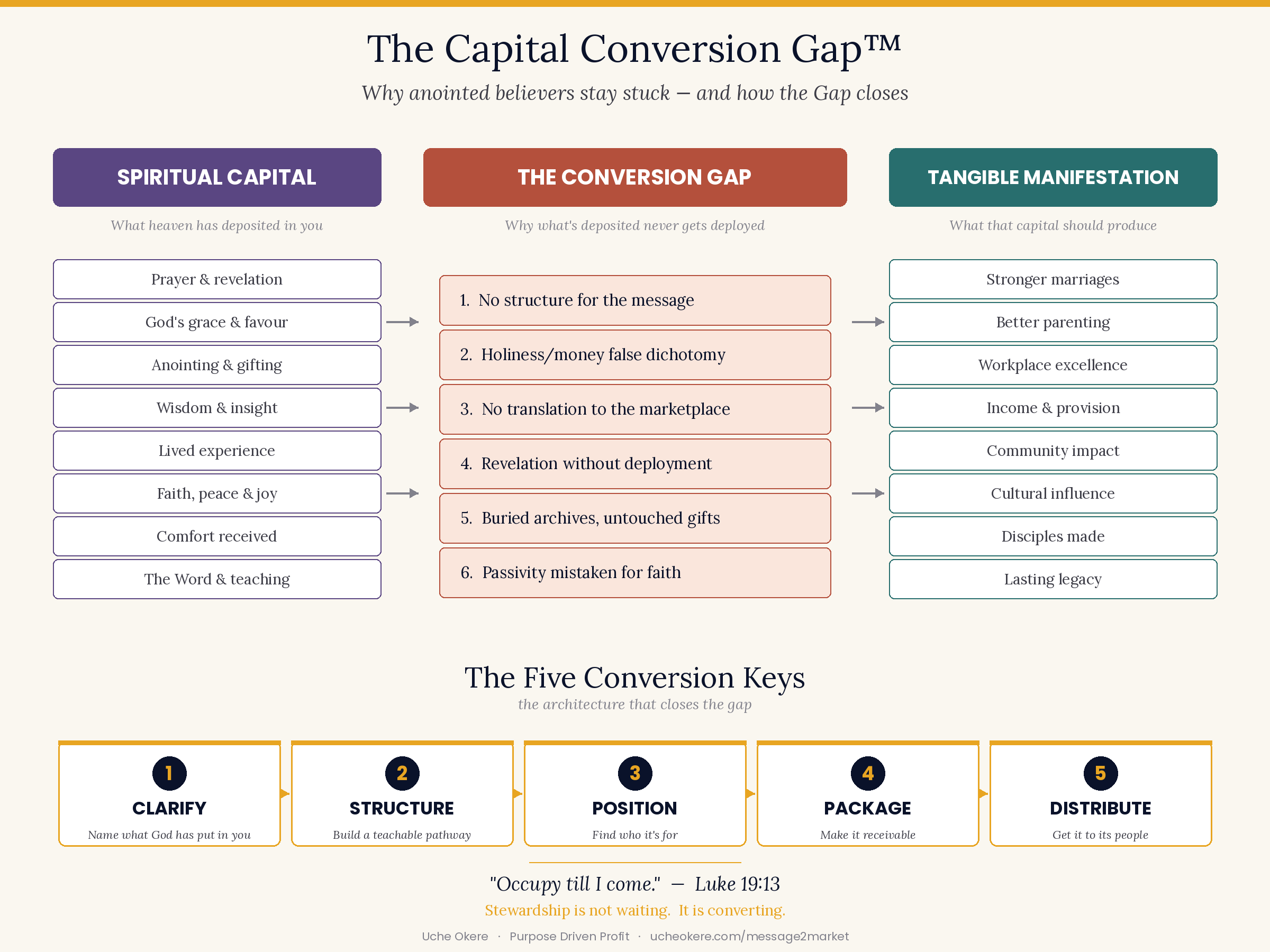
The real diagnosis is structural, in the sense that the believer has accumulated genuine spiritual capital over many years of obedience, study, ministry, and faithful work, and has simply never been taught the architecture that converts that capital into visible Kingdom fruit. The result is a gap between what they carry on the inside and what they are actually producing on the outside. That gap is what I call the Capital Conversion Gap™.
This article exists to give that gap a name, a definition, a cause, and a faithful next step. If you have ever sensed that you are carrying far more than you have managed to release, what I want to do here is give you language for what has been happening to you, and then walk you toward a way out of it that is theological, practical, and grounded.
01A short answer for the reader who needs one now
The Capital Conversion Gap™ is the chasm between the spiritual capital a believer has received and the tangible Kingdom outcomes that capital was deposited to produce. It is caused not by insufficient faith, gifting, or anointing, but by the missing architecture that translates invisible deposits into visible fruit.
What I mean by spiritual capital is something quite specific, in the sense that it includes both what God deposits in a believer at salvation and what He forms in that believer through the years of life, suffering, obedience, ministry, work, and stewardship that follow. So the gap appears when that accumulated capital is sitting on the inside but is not being deployed on the outside — when a believer is rich in revelation but poor in pathway, full of message but absent of structure, anointed in the prayer room but invisible in the marketplace.
The way the gap is closed is through five conversion keys, which are clarify, structure, position, package, and distribute. And the rest of this article is going to walk you carefully through what spiritual capital actually is, why this gap exists in the first place, what Scripture itself says about it, and what the first honest step toward closing it looks like.
02The diagnosis I keep encountering
Let me describe the pattern more carefully, because I think it will help you locate yourself in it. The person is faithful. They pray. They have a real walk with the Lord. They have been formed by years of suffering, study, ministry, work, and obedience, and they have something genuine to give. When they teach, people are helped. When they write, the work has weight. When they preach, the room shifts. None of that is in doubt.
And yet, when I sit with them, what I notice is that the book they wrote has not become a pathway. The sermon archive they have built over twenty years has not become a body of work. The message they carry has not become an offer that anyone can actually take hold of. The calling they sense has not become a clear assignment in the marketplace. The gifting they have been given has not become a structure that serves people consistently. They are carrying real capital, and that capital has simply not yet been converted into observable Kingdom fruit.
The things they say to me in these conversations sound almost identical, regardless of whether the person is a pastor, an author, or a corporate executive who senses there is a Kingdom assignment on his life. They say, "I know what I am supposed to do, but I cannot seem to make it land." They say, "People tell me my preaching changes them, but I do not know how to turn that into anything." They say, "I have written the book, but no one's life has changed because of it the way I hoped it would." They say, "I have been called for years, and I am still invisible."
And what I have come to learn is that the temptation in the church, when these believers come for counsel, is to read this as a spiritual deficit and to prescribe more prayer, more breakthrough, and more deliverance. The temptation in the marketplace, when they go for coaching outside the church, is to read this as a marketing deficit and to prescribe more funnels, more ads, and more positioning. Both prescriptions, in my experience, miss the actual problem.
The actual problem, as I see it, is that the believer was discipled into accumulation and was never taught conversion. What I mean is that they were carefully taught how to receive, study, intercede, attend, and be filled. They were never taught how to clarify what they carry, how to structure it into something deployable, how to position it in front of the people it was meant to serve, how to package it into a pathway people can actually walk, and how to distribute it consistently. That missing competency, that absent architecture, is what I have come to call the Capital Conversion Gap™.
03What spiritual capital actually is
To understand the gap, you have to first understand what spiritual capital is and where it comes from, because if the term sounds unfamiliar in your ears, I want you to see that Scripture itself is not at all shy about using this kind of language. Ephesians 1 speaks of every spiritual blessing in the heavenly places. 2 Peter 1 speaks of everything we need for life and godliness having already been granted to us. 2 Corinthians 8 speaks of Christ becoming poor so that we, through His poverty, might become rich. Deuteronomy 8 speaks of God giving His people the koach, the capacity, for wealth. So when I use the word "capital," what I am doing is not grafting a marketplace category onto the gospel. I am recovering a vocabulary the New Testament itself uses to describe what has happened to the believer.
And what I have come to see is that spiritual capital divides naturally into two layers, which I want to walk you through.
Primary spiritual capital
Primary spiritual capital is what is received in Christ at the moment of salvation. It is given, not earned, in the sense that it does not depend on platform, calling, gifting, or vocation. It includes the indwelling Holy Spirit, the gifts that are distributed to every believer, the power that has been granted for life and godliness, the riches that have been deposited through union with Christ, and the access that has been opened to the throne of grace. Every believer in the room carries this, whether they are a senior pastor or a quiet intercessor who has never stood behind a microphone.
Secondary spiritual capital
Secondary spiritual capital, on the other hand, is what is formed in the believer over time. It is not given fully formed at salvation, but rather accumulates across the years through obedience, suffering, study, ministry, work, relationship, and stewardship. What I see in the believers I serve is that this secondary capital takes several forms — there is revelation capital, which is what God has shown you over the years; experience capital, which is what He has carried you through; mastery capital, which is what you have developed through faithful work; relationship capital, which is the trust and access you have built; stewardship capital, which is what you have been entrusted with; and created capital, which is the books, sermons, frameworks, recordings, courses, and tools you have already produced.
And what I have learned is that most believers carry far more secondary capital than they realise. The pastor who has been preaching for twenty years has created capital sitting in a folder. The author has revelation capital pressed into a book that has not yet become a pathway. The coach has mastery capital distilled across hundreds of conversations she has already had. The professional has experience capital that could serve people who are still in the wilderness she has already crossed. This is the inventory, in the sense that it is real, it is theologically grounded, and it is convertible.
04Why the gap exists
So if the capital is real and the believer is faithful, the natural question is why the gap persists at all. And what I have seen, after years of working with pastors, authors, coaches, and Kingdom-minded professionals, is that there are six causes that show up again and again. I want to name them briefly here, and I will return to each of them in future articles.
The first cause is that the message itself has no structure, in the sense that the believer has revelation but no framework. People are moved when they hear them speak, but no one can repeat what they teach, because there is nothing to repeat. The teaching is true, but it is unrepeatable.
The second cause is what I call the sacred-secular lie, which is the belief that converting your message into something people pay for is somehow less holy than giving it away unstructured. And what I have come to learn is that this lie keeps faithful believers from ever building the very infrastructure that would let their message actually reach the people it was meant to serve.
The third cause is no market translation, by which I mean that the believer is fluent in church language and cannot translate the same revelation into the language of the people they are trying to reach. The Christianese is so internalised it has become invisible to them, and the wider market — the very people the message was meant for — cannot find a door in.
The fourth cause is revelation without deployment architecture. The believer has been shown things by the Spirit, but has not been taught how to deploy what they have been shown. They have notebooks of insight and no infrastructure to carry it. What I mean is that the Spirit gave them content, but no one ever gave them container.
The fifth cause is the buried archive, in the sense that years of sermons, notes, posts, transcripts, drafts, frameworks, and outlines are sitting dormant in folders on a hard drive somewhere. The created capital exists. It has simply never been mined, structured, or deployed.
The sixth cause is passivity mistaken for faith, which is something I see often. The believer has been taught that doing nothing and waiting on God is somehow more spiritual than building, and so stewardship has been quietly rebranded as striving. So they wait. And the talent stays buried.
What I have noticed is that most of the believers I work with have at least three of these six operating at once, sometimes four or five. Naming them is where the diagnosis begins. Closing them is where the work of conversion lives.
05What the parable of the talents actually condemns
If you are uneasy about treating spiritual realities in the language of capital, conversion, and deployment, I want to walk you carefully through the parable of the talents in Matthew 25, because I think it will settle something for you.
In that parable, three servants are given capital. Two of them trade with it and produce more. The third one buries it and gives it back to the master unchanged. And what I want you to notice, very carefully, is what the master actually condemns. The third servant did not lose the talent. He did not spend it. He did not squander it. He preserved it. He kept it safe. He gave back exactly what he had been given.
And the master called him wicked.
The wickedness, in other words, was not in losing the capital. The wickedness was in failing to trade with it. The Greek word that Jesus uses in a parallel passage — pragmateuomai, in Luke 19
— literally means to transact, to trade, to do business. The command was conversion. The condemnation was for accumulation without conversion.This, in my reading, is the theological heart of the framework. The believer who carries genuine spiritual capital and never converts it is not in a neutral position before God, in the sense that the parable does not allow neutrality. The third servant thought he was being safe. The master called him faithless.
What I have come to understand is that the Capital Conversion Gap™ is simply the modern, structural form of the third servant's mistake. The capital is real. The accumulation is real. The conversion is absent. And the gap between what was received and what was deployed is the very thing the master is going to look at when He returns.
I want to be clear that I am not framing this as a guilt motivation. I am framing it as a stewardship reality. If you have been carrying capital that you have not yet converted, the gospel does not say to you, "Strive harder." What the gospel says is, "Trade. Structure what you have. Build what you have been given to build. Make it available to the people it was deposited to serve."
06The five conversion keys, in one breath
The way I close the Capital Conversion Gap™, in the work I do, is through five conversion keys, and I want to give you the architecture in one pass here so you can see the shape of it. I will write a full pillar article on each of them in time.
Clarify. What I mean by this is that you have to be able to name what you actually carry. Most believers I work with cannot articulate, in plain language, what their actual message is, what specific problem it addresses, and who exactly it is for. And what I have come to learn is that clarification is not a marketing exercise, in the sense that it is fundamentally a stewardship exercise. You cannot deploy what you cannot describe.
Structure. Once you have clarified, the next thing is to turn the message into a framework, in the sense that a framework is repeatable, a framework is teachable, and a framework gives people something to hold on to long after the sermon, the conversation, or the book has ended. Without structure, the revelation evaporates the moment the room empties.
Position. What positioning means, as I use the term, is that you have to stand in front of the very people the message was deposited to serve. And I want to say carefully that positioning is not self-promotion. It is faithful presence in the right room, speaking in language that room understands, with credibility that room can actually verify.
Package. Packaging is the act of turning the framework into something people can take hold of, whether that is a workshop, a book, a course, a pathway, a coaching offer, an assessment, or a diagnostic. What I mean is that packaging is the building of the container that lets the message be received without being diluted.
Distribute. And then finally, distribution is the long obedience of getting the package into the hands of the people who need it. I want to be clear that distribution is not noise. What it actually is, is consistent, faithful, repeatable presence — putting the right message in front of the right people in the right room over time.
These five keys are the architecture. They are not a marketing funnel, in the sense that I am not asking you to adopt a sales system. What I am offering you is a stewardship discipline. This is how the third servant in the parable should have traded with what he had been given.
07How to know your Capital Conversion Gap™ is open
There are three honest signals I want you to test yourself against, because what I have come to learn is that most believers know intuitively when the gap is open in their lives but lack the language to name where exactly it sits.
The first signal is that you cannot describe, in two clean sentences, what you do and for whom. What I mean is that if your description requires three minutes, four caveats, and a tangent into your testimony, the message has not been clarified yet. The gap is open at the first key.
The second signal is that you have produced more than you have converted. The sermons exist. The notes exist. The drafts exist. The book exists. The framework exists. But none of it is currently doing the work of carrying people through a transformation. You are sitting on created capital that has not yet been deployed, which means the gap is open somewhere between structure, packaging, and distribution.
The third signal is that the people you have been called to serve cannot find you, or when they find you, they cannot understand what to do next. There is no pathway. There is no first faithful step. There is no clear invitation. The gap is open at distribution.
And what I want to say to you is that if even one of these three is true of you, the gap is not theoretical. It is operating in your life right now. And it can be closed.
08The first faithful next step
The work of closing the Capital Conversion Gap™ does not begin with hiring a marketer, writing a book, or building a funnel. What I have come to learn is that it begins with honest diagnosis, in the sense that you need to know where, precisely, the gap is open in your particular situation, and what kind of capital you are sitting on that has not yet been converted.
This is why I built the Capital Conversion Gap™ Diagnostic. It is free, it takes about ten minutes, and what it does is give you a clear read on the capital you are actually carrying, the points in the conversion architecture where you are blocked, and the next faithful step that fits your specific situation rather than a generic one. You can take it here: https://capitalconversiongap.com.
What I want to leave you with is the same thing the parable leaves us with. The third servant did not need more talent. What he needed was to trade with what he had already been given. That is the work in front of you. And it begins with seeing clearly what you carry.
09Frequently asked questions
What is the Capital Conversion Gap™ in one sentence?
The Capital Conversion Gap™ is the structural gap between the spiritual capital a believer has received and the visible Kingdom outcomes that capital was deposited to produce.
Is the Capital Conversion Gap™ a faith problem?
No, what I have come to learn is that it is an architecture problem. Most believers facing the gap have genuine faith, real anointing, and substantial accumulated capital. What they lack is the conversion competency the church has not historically taught.
What is the difference between primary and secondary spiritual capital?
Primary spiritual capital is what is received in Christ at salvation — the indwelling Spirit, the gifts of grace, the riches of union with Christ. Secondary spiritual capital is what is formed through life and stewardship, which includes revelation, experience, mastery, relationship, stewardship resources, and created assets like books and sermons.
Is converting spiritual capital the same as monetising your faith?
No, in the sense that conversion produces visible Kingdom fruit, which may include income, but income is stewardship infrastructure and not the highest aim. Conversion is the work the parable of the talents commands. Monetisation is one possible expression of faithful conversion, never its purpose.
Where do I start if I think my Capital Conversion Gap™ is open?
The first faithful step is to take the Capital Conversion Gap™ Diagnostic at capitalconversiongap.com. It will tell you which conversion key is most blocked for you and what next step actually fits your situation.
About the author
Uche Okere
Dr Uche Okere is a pastor, university academic, coach and founder of Kingdom Builders AI Studio. He helps pastors, authors, speakers and faith-driven builders convert spiritual capital into visible Kingdom impact through message architecture, AI tools, workshops and practical implementation.
Explore the Studio