TL;DR
- A Book Brief turns a book idea into a working plan.
- Define the reader, central argument, source material and chapter progression, then test the structure.
- AI can assist, but it cannot guarantee accuracy, publication or sales.
In this article
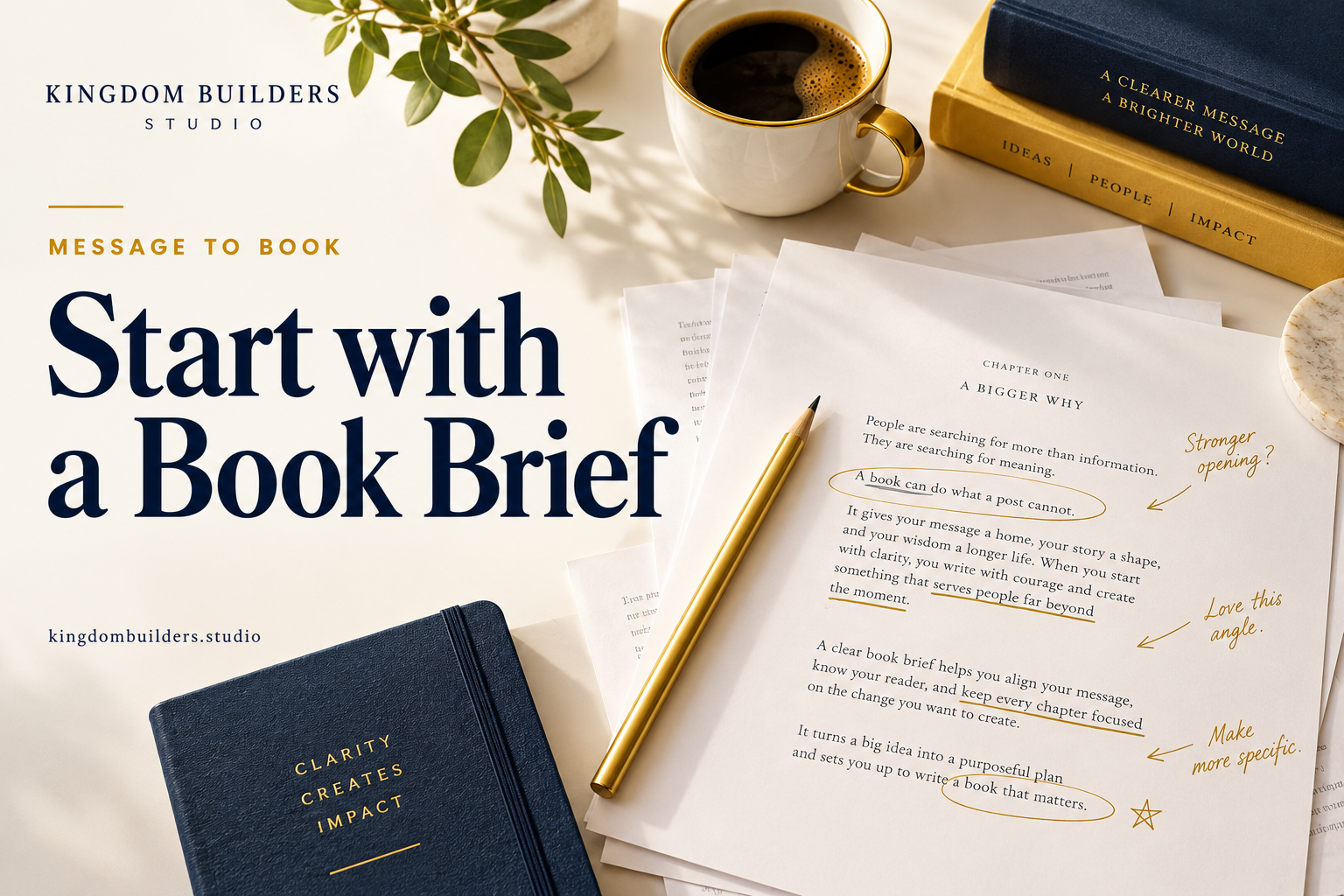
A Book Brief is a working plan for your book: who it serves, what it argues, which material belongs in it, and how the chapters will help the reader move forward. It gives you a way to make decisions before you spend weeks drafting pages that may not belong together.
For a Christian author, that planning also involves theological responsibility. You need to know which biblical texts support your argument, where your interpretation needs careful explanation, and which claims you are qualified to make. A compelling idea deserves that care.
You can begin with notes and a blank document. AI can assist with organising the material and suggesting options, but the decisions remain yours. A brief cannot guarantee publication, sales or bestseller status. Its value is more immediate: it helps you see what you are actually trying to write.
01What belongs in a Book Brief?
Start with the reader. “Christians” is too broad to guide most editorial decisions. A newly appointed ministry leader struggling to delegate has different questions from a retired pastor reflecting on a lifetime of ministry. Describe the person, the situation they face and the question that brings them to your book.
Then state the central argument. Complete this sentence: “This book argues that…” If the answer contains six unrelated ideas, you may have several projects competing for the same manuscript. Choose the argument this particular book can develop responsibly.
A useful brief also includes:
- The reader's starting point: what they already know, what troubles them and what language they use.
- The intended help: what the book equips them to understand or practise, without promising an outcome you cannot control.
- The source material: sermons, teaching notes, research, experiences and permissions you already hold.
- The chapter progression: the question each chapter answers and why that question belongs at that point.
- The boundaries: topics the book will not cover, claims that need research and stories that require permission.
Keep this document usable. A brief that helps you decide what to include is more valuable than a polished document you never consult again.
02Turn an archive into an argument
Suppose, as a teaching example, you have several sermons about leadership. One concerns delegation, another exhaustion, another prayer and another team conflict. Their shared topic does not automatically make them chapters of the same book.
If your reader is an overwhelmed new ministry leader, the argument might be that responsible leadership includes sharing work and developing other people. You would then ask which parts of each sermon serve that argument. Some passages will fit; others belong elsewhere. You may discover that the archive says little about how to have a difficult conversation with a volunteer. That is a gap to research and write, not a reason to fill pages with unrelated material.
For the organising process, read From Scattered Sermons to a Cohesive Book. For choosing your starting material, use Which sermon series should become your first book?.
03Where AI can help
Give the tool a defined task and selected source material. Ask it to compare possible chapter orders, identify repetition or list questions your notes leave unanswered. Request that it distinguish material found in your sources from its own suggestions.
An instruction such as “Write a bestselling Christian book” provides almost none of the information needed for responsible authorship. A more useful instruction is: “Using these three teaching outlines, propose two chapter sequences for this reader. Explain the purpose of each chapter and flag anything that needs further evidence.”
Treat the response as an editorial proposal. Check whether the suggested sequence represents your argument. Verify every Scripture reference and quotation. Remove invented experiences or claims. A plausible title is a suggestion to test with readers; it is not evidence of market demand.
04Test the brief before drafting
Read the proposed chapter titles in order. Can you explain why each chapter follows the previous one? Can a reader understand the promise without knowing your ministry vocabulary? Does the book have enough substance to fulfil that promise?
Ask a small number of people who resemble your intended reader what they expect to learn from the description. Listen for misunderstandings. You are testing clarity, not asking them to endorse a book they have not read.
Finally, choose one chapter and map its source material. This small exercise often reveals more than another round of title brainstorming. If you cannot find the argument, evidence and application for that chapter, revise the brief before expanding it.
05A practical next step
Bring your working idea and a sample of existing material to the free Live Book Brief session. Check the registration page for the current session details. You do not need a finished manuscript to begin clarifying the project.
06FAQ
Is a Book Brief the same as a manuscript?
No. It is a planning document. Drafting, revision, theological and factual review, editing and production still follow.
Must I use AI to create one?
No. You can prepare a brief yourself or with an editor. AI is one possible aid for comparing and organising ideas.
Does a strong brief guarantee book sales?
No. Reader demand, the finished book's quality, distribution and many other factors affect sales. A brief helps you make a clearer book; it cannot promise a commercial result.

Dr Uche Okere
Dr Uche Okere is a pastor, university academic, coach and founder of Kingdom Builders AI Studio. He helps pastors, authors, speakers and faith-driven builders convert spiritual capital into visible Kingdom impact through message architecture, AI tools, workshops and practical implementation.
Explore the Studio